
Every year, millions of birds leave their homes and travel thousands of kilometers to new places. This journey, called migration, is one of the most impressive events in nature. How do birds know where to go, and how do they find their way over such great distances? Scientists have studied this question for many years, and their findings reveal an amazing story of natural skills and abilities.
For centuries, people watched birds disappear in autumn and come back in spring. Early theories were often strange—some believed swallows spent winter buried in mud. Today, we know birds migrate to find food, escape cold weather, or find the best places to raise young. But the real mystery is: how do birds navigate during migration? They cannot ask for directions, use a GPS, or read maps. Yet, they cross oceans, deserts, and mountains, often returning to the exact same tree or nest each year.
Understanding how birds navigate gives us insight not only into bird behavior but also into the power of natural adaptation. It involves senses, memory, and even the Earth’s magnetic field—tools far beyond what most humans use. This article explores the secrets behind bird migration, the navigation tools they use, and the latest scientific discoveries.
By the end, you will see birds not just as simple creatures, but as skilled travelers with abilities that still surprise experts today.
The Basics Of Bird Migration
Migration means moving from one place to another, usually to find better living conditions. For birds, migration is often a long-distance journey that happens every year. Many birds travel between their breeding grounds (where they raise their young) and their wintering grounds (where they find food and shelter).
Some birds migrate just a few kilometers, while others, like the Arctic tern, travel over 70,000 kilometers every year. Most migration happens in spring and autumn. The timing is important—birds need to leave before it gets too cold or food runs out, and arrive when new food and nesting places are available.
There are two main types of migration:
- Short-distance migration: Some birds move only a short way, often to lower ground or a nearby region with more food.
- Long-distance migration: Other birds, like swallows or geese, fly across continents and oceans.
These journeys can be dangerous. Birds face bad weather, predators, and exhaustion. So, finding the right path is critical. The question is, how do they do it?
Main Navigation Tools Birds Use
Scientists have discovered that birds use several natural tools to find their way. Most birds do not use just one method, but combine several for the best results.
1. Sun Compass
Many birds use the sun’s position as a compass. During the day, the sun moves across the sky from east to west. Birds can tell direction by watching where the sun is.
However, the sun’s position changes with time. Birds have an internal clock that helps them adjust. For example, if a bird knows it is morning, and the sun is in the east, it can fly south by keeping the sun on its left.
If it’s afternoon, the same sun position means something different, so the bird adjusts its flight.
Experiments have shown that if a bird’s internal clock is changed (for example, by keeping it in darkness), the bird can get confused about direction. This proves that both the sun and the bird’s sense of time are important for navigation.
2. Star Compass
At night, many birds use the stars to guide them. Young birds raised under artificial stars will follow the fake “north” made by those stars. The most important star is Polaris, the North Star, which stays in the same place in the sky.
Birds learn the pattern of stars in the sky and use them like a map. Even if clouds cover the sky, many birds can remember the star map for short periods and keep going in the right direction.
3. Earth’s Magnetic Field
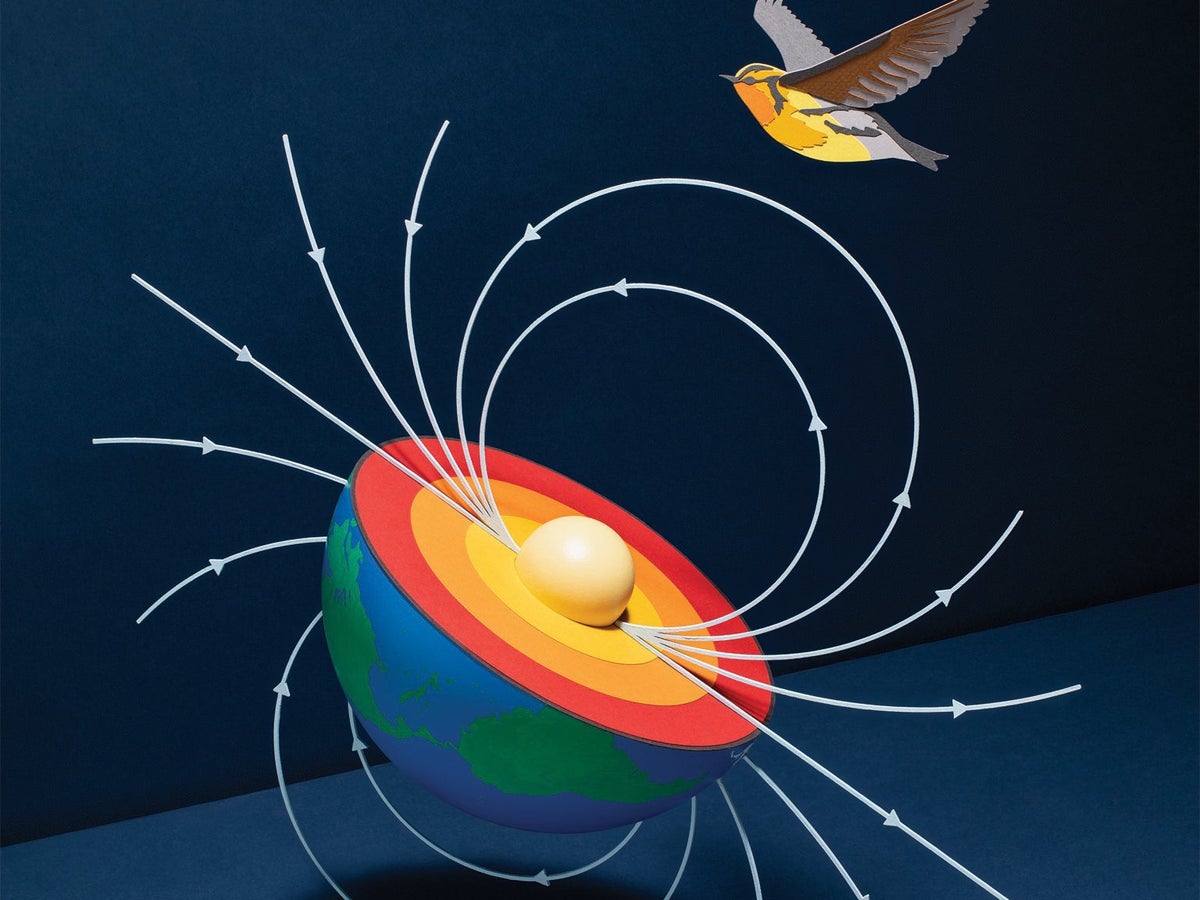
One of the most amazing discoveries is that birds can sense the Earth’s magnetic field. This helps them know which way is north or south, even when the sun and stars are hidden.
Birds seem to have special cells in their bodies (possibly in the beak or eyes) that can “feel” magnetism. Some birds even have small bits of iron in their heads, which act like a compass needle.
Scientists have done tests by putting magnets near birds, which can confuse their sense of direction. In other experiments, birds in total darkness still flew the correct way, showing they were using the Earth’s magnetism.
4. Landmarks And Visual Cues
As birds get close to their destination, they often use landmarks—mountains, rivers, coastlines, or even city lights. Large birds like cranes and geese often follow the same rivers or mountain ranges each year. Pigeons are famous for finding their home lofts from hundreds of kilometers away, using familiar sights.
Urban birds may use buildings, roads, or even airports. Some birds can even recognize individual trees or fields.
5. Sense Of Smell
For a long time, people thought birds did not use smell. But recent studies show that some birds, especially seabirds and pigeons, use smell to find their way. In experiments, birds with blocked noses often get lost, while those with working noses navigate correctly.
The Cory’s shearwater, a seabird, can find its island home in total darkness just by smell. Pigeons also use smells in the air to build up a “map” of their region.
6. Memory And Learning
Many birds do not rely only on natural senses—they also use memory. Older birds often follow paths they learned as young birds, sometimes flying with parents or flocks. Each year, they improve their “mental map” of the world.
Some birds, like crows and jays, are famous for their intelligence. They remember where food is hidden, which helps them survive on long trips.
7. Inherited Genetic Programs
Not all navigation is learned. Some birds are born with an inherited map and compass. Young birds raised alone, with no adult guides, still migrate in the correct direction. This shows that some migration routes are “built in” from birth.
For example, young blackcaps (a small songbird) kept in cages in Germany showed a strong urge to fly southwest in autumn, even if they had never seen the outside world.

How Birds Combine Navigation Tools
In real life, birds usually combine several navigation methods. If one tool fails (like the sun is hidden by clouds), they use another (the Earth’s magnetic field or landmarks). This backup system makes bird migration very reliable.
Here is a summary table of which tools different birds use:
| Bird Species | Sun/Stars | Magnetic Field | Landmarks | Smell |
|---|---|---|---|---|
| Swallow | Yes | Yes | Some | No |
| Pigeon | Yes | Yes | Yes | Yes |
| Arctic Tern | Yes | Yes | Limited | No |
| Cory’s Shearwater | No | Yes | No | Yes |
This table shows that no single navigation tool works for all birds. Instead, each species uses the best tools for its own needs.
Real Examples: Amazing Bird Migrations
Some birds make journeys so long and difficult that they are hard to believe. These migrations show how powerful bird navigation can be.
Arctic Tern
The Arctic tern holds the record for the longest migration. Every year, it flies from the Arctic (north) to the Antarctic (south) and back—a round trip of over 70,000 kilometers. This means it sees more daylight in a year than any other animal on earth. Scientists use satellite tags to track these birds. The terns use a mix of sun, stars, and magnetic field to find their way, even over open ocean where there are no landmarks.
Bar-tailed Godwit
The bar-tailed godwit is another champion migrant. It can fly nonstop for over 11,000 kilometers from Alaska to New Zealand in just eight days. This is the longest known nonstop flight by any bird. These godwits do not stop for food or rest, and must plan their trip very carefully using the sun, stars, and magnetic field.
Homing Pigeon
Homing pigeons are famous for their ability to return home from hundreds of kilometers away. They are used in races and to deliver messages. Pigeons use the sun, landmarks, and smell to find their way. In experiments, pigeons with magnets on their heads, or with their noses blocked, often get lost. This proves they use more than one tool for navigation.
Common Cuckoo
The common cuckoo travels from Europe to Africa each year. Young cuckoos migrate alone, without parents. They still find the correct wintering grounds, showing their migration is controlled by genes. Cuckoos use the stars and magnetic field to guide them, and may also use wind patterns.
Blackpoll Warbler
The blackpoll warbler is a small songbird that flies up to 3,000 kilometers nonstop over the Atlantic Ocean. It weighs just 12 grams, but can cross from North America to South America in three days. This bird relies on the stars, sun, and internal compass, as there are no landmarks over the ocean.
The Science Behind Navigation: Key Experiments
Scientists have used many clever experiments to discover how birds navigate. Here are some of the most important findings.
Clock-shift Experiments
Researchers changed the internal clocks of birds (by changing the light-dark cycle in the lab). When released, these birds flew in the wrong direction, showing they use the sun and an internal clock to find their way.
Star Map Experiments
Young birds raised in planetariums with fake star maps learned to use those stars for navigation. When the “north” star was moved, the birds changed their migration direction. This showed that birds learn the real sky map by watching the stars at night.
Magnetic Field Manipulation
Birds with small magnets placed near their heads often got lost. In other experiments, scientists created artificial magnetic fields in the lab. Birds changed their direction according to the new field, proving they can sense magnetism.
Olfactory (smell) Blocking
Pigeons and seabirds with their noses blocked could not find home, while those with normal smelling ability succeeded. This suggests that smell is important, especially near familiar places.
The Role Of Weather And Wind
Weather plays a big part in migration success. Birds must choose the right time to leave, to avoid storms or strong headwinds. Some birds wait for tailwinds, which help them fly faster and save energy.
Many birds use wind patterns to their advantage. For example, the blackpoll warbler waits for favorable winds before crossing the Atlantic. If the wind changes, birds may land and wait for better conditions.
Some birds can sense air pressure changes, helping them predict the weather and avoid danger.

Dangers And Mistakes During Migration
Migration is risky. Birds can get lost if their navigation tools fail. Bad weather, human-made obstacles (like glass buildings or lights), and changes in the environment (like disappearing wetlands) can cause problems.
Young birds are more likely to make mistakes, as their skills are not fully developed. Sometimes, birds end up in the wrong place—a phenomenon called vagrancy. For example, a bird from Asia might appear in Europe, thousands of kilometers off course.
Here is a comparison of common migration dangers:
| Danger Type | Impact on Birds | Prevention/Adaptation |
|---|---|---|
| Bad Weather | Can blow birds off course or cause exhaustion | Wait for good conditions, adjust route |
| Loss of Landmarks | Causes confusion near cities or altered landscapes | Use backup tools (magnetic field, smell) |
| Light Pollution | Leads birds to fly into cities or windows | Change route, fly at different times |
| Predators | Increases risk, especially for young birds | Migrate in flocks, fly at safe times |
Two Insights Most People Miss
Many people think bird migration is only about following a simple path. But two key details are often missed:
- Bird navigation is flexible: Birds can switch between navigation tools as the situation changes. For example, a bird may use the sun during the day, stars at night, and smell or landmarks near home. This flexibility is a big reason why migration is so successful.
- Navigation skills can improve with experience: Young birds often make more mistakes than adults. Over time, birds learn better routes, remember good stopover sites, and become more efficient travelers. In other words, migration is both instinctive and learned—a blend of nature and experience.
The Future Of Bird Navigation Research
New technology is helping scientists learn even more about bird migration. Tiny GPS trackers, satellite tags, and weather radar allow researchers to follow birds in real-time, even over oceans. As methods improve, scientists are discovering that some birds take different routes each year, depending on weather, food, and experience.
Genetic research is also helping us understand how navigation skills are inherited. Some scientists are trying to identify the exact genes that control migration direction and timing.
There are still mysteries to solve. For example, how exactly do birds “feel” the Earth’s magnetic field? Some evidence suggests birds may even see magnetic fields as patterns in their eyes, but the process is not fully understood.
Why Bird Migration Matters
Bird migration is not just an amazing natural event—it is also important for ecosystems and people. Migrating birds spread seeds, control insect populations, and connect different parts of the world. They are indicators of environmental health. When migration goes wrong (for example, when wetlands disappear), it is a warning sign that something is wrong with the planet.
Conservation efforts are now focused on protecting migration routes and stopover sites. Without these, even the best navigation skills will not help birds survive.
If you want to learn more, the Wikipedia Bird Migration page has excellent information and links to current studies.
Frequently Asked Questions
How Do Birds Know When To Start Migrating?
Birds use several signals to decide when to migrate. The most important is day length—as days get shorter or longer, birds feel hormonal changes that tell them it’s time to move. Temperature, food availability, and weather also play roles. Some birds even sense air pressure changes before storms.
Do All Birds Migrate?
No, not all birds migrate. Some species stay in the same area all year, especially if food is always available. Others migrate short or long distances. In general, birds in cold climates are more likely to migrate than those in tropical areas.
Can Birds Get Lost During Migration?
Yes, birds can get lost, especially young or inexperienced ones. Bad weather, loss of landmarks, or human changes to the environment can all cause mistakes. However, most birds have backup systems and usually find their way.
How Do Scientists Track Migrating Birds?
Scientists use many tools to track birds. These include banding (putting small rings on birds’ legs), GPS trackers, satellite tags, and radar. New technology lets researchers follow even small songbirds across continents.
What Happens If A Bird’s Navigation Sense Is Blocked?
If a bird’s main navigation tool is blocked (for example, its sense of smell or magnetism), it may have trouble finding its way. Some birds can switch to other tools, but others may get lost. Experiments show that pigeons with blocked noses or birds with magnets attached often fly in the wrong direction.
Bird migration is a story of survival, skill, and adaptation. Each journey is a test of natural navigation—one that continues to inspire scientists and bird lovers alike.