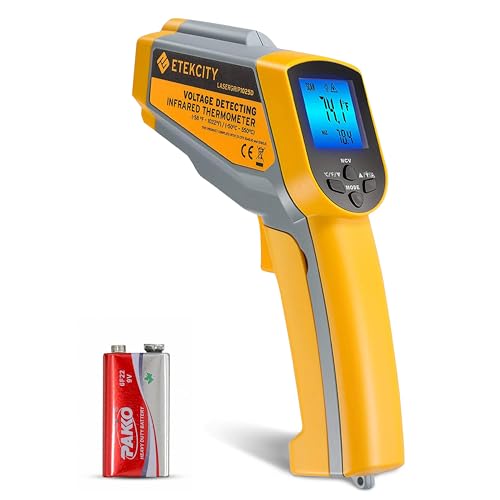
Simple, accurate, and budget-friendly non-contact temperature gun for home and shop use.
You know that moment when a hot pan or a cold pipe needs a quick temp check and a probe is risky? The Etekcity Infrared Thermometer 1025D solves that. It lets you grab surface temps fast without touching. I used it for grilling, HVAC checks, and car cooling system diagnostics. It saves time, keeps you safe, and helps you make the right call when heat matters.
Is Etekcity Infrared Thermometer 1025D Good?
I give a clear yes with some context. The Etekcity Infrared Thermometer 1025D is a solid buy if you want fast surface readings for projects at home, in the garage, or around the kitchen. It is not for taking human body temperature, and the packaging states that clearly. For my needs—checking oven surfaces, air vents, and radiators—it was reliable and quick. The readout is instant. Battery life lasts for many sessions. Accuracy is good for non-contact checks, as long as you understand emissivity limits and distance-to-spot math. Overall, it’s great for DIYers, cooks, and light pros who need a budget infrared gun.

My First Impression for Etekcity Infrared Thermometer 1025D
The unit arrived in a compact box with a clear manual and a small plastic bag for the gun. The build feels lightweight but solid. The yellow-and-gray plastic is firm and the trigger clicks with a positive feel. The display is bright and easy to read. Setup was plug-and-play: pop in a 9V battery, point, and pull the trigger. My first test on a stovetop matched my oven probe within a few degrees, which was pleasant. I felt relieved that a cheap infrared gun could be this consistent. I was impressed and ready to use it across several tasks.

What Makes It Stand Out / Key Features
- Wide temp range: -58°F to 1022°F (-50°C to 550°C)
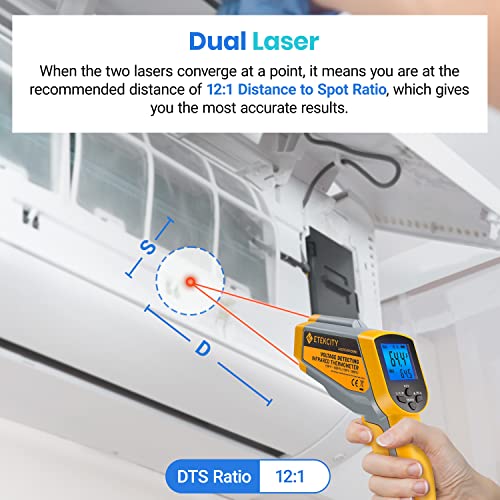
- Dual laser pointer for better aiming and a clear distance-to-spot
- Adjustable emissivity to improve accuracy on various surfaces
- Non-contact voltage tester (NCV) built into the unit for added safety checks
- Quick response time with instant LCD readout and backlight
- Auto shut-off and battery-saver features for longer use
What I Like
- Fast, repeatable readings—great when you need speed
- Good value for the cost—features rival pricier models
- Adjustable emissivity helps get closer to true surface temps
- Dual laser makes aiming intuitive and reduces errors
- Compact and lightweight; easy to carry in a tool bag

What Could Be Better
- Not designed for measuring human body temperature
- Accuracy drops if you don’t account for emissivity or distance
- The plastic housing could feel more rugged for heavy trades use

My Recommendation
If you need a practical, budget infrared gun, the **Etekcity Infrared Thermometer 1025D** is a smart pick. It fits cooks who watch hot pans, homeowners checking vents, and DIY mechanics testing engine parts. It’s not a medical device. For general surface work, it saves time and makes your checks safer. I recommend it for people who want a balance of price and features. It’s easy to buy and offers strong value for home and hobby use.
| Best for | Why |
|---|---|
| Home cooks | Quick surface checks on pans and grills without probe holes |
| DIYers & hobbyists | Portable and precise enough for engine and electronics surface checks |
| HVAC checks | Useful for duct and vent temperature scans to spot problems fast |

Alternative Products You Can Consider
Fluke 62 MAX+ — Best for pros who need rugged build and lab-level accuracy. It costs more but offers tighter specs and IP54 protection. If you measure temps daily on job sites, this is a step up.
Klein Tools IR5 — A mid-range choice with dependable accuracy and a compact design. It’s good for electricians and HVAC techs who want a trusted brand without big cost jumps.
ThermoPro TP30 — Budget friendly and easy to use for home cooks and hobbyists. It trades advanced features for a lower price but still covers most casual needs well.
| Product | Best For | Key Difference |
|---|---|---|
| Etekcity Infrared Thermometer 1025D | Budget-conscious users | Great feature set at a low price |
| Fluke 62 MAX+ | Field pros | Rugged, higher accuracy, weather resistant |
| Klein Tools IR5 | Electricians & HVAC techs | Good balance of price and pro features |
| ThermoPro TP30 | Home use and cooking | Lower price, simpler feature set |

Final Verdict: Which Should You Buy?
For most users who need a reliable, low-cost infrared thermometer, the Etekcity Infrared Thermometer 1025D delivers great value. It is fast, offers adjustable emissivity, and has a wide temp range. If you are a professional who needs rugged gear and top-tier accuracy, consider the Fluke 62 MAX+. If you are a casual user or cook, the ThermoPro TP30 is easier on the wallet and still useful. My pick: the Etekcity model for balanced price and performance.

FAQs Of Etekcity Infrared Thermometer 1025D Reviews
Can I use this to check body temperature?
No. This infrared gun measures surface temperatures only. It’s not calibrated for human body use. For body temps, use a medical thermometer designed for that purpose.
How accurate is the Etekcity gun?
It’s accurate for surface readings within its spec when used correctly. Accuracy improves when you adjust emissivity for the material and respect distance-to-spot ratios. Expect a small variance compared to probe thermometers.
Is the dual laser safe to use?
Yes. The dual laser is only for aiming. Avoid staring into the laser and do not point it at eyes. It helps you pinpoint where the sensor reads.
Does it need special maintenance?
Keep the lens clean and protected. Store the unit in a dry place. Replace the 9V battery when the display dims. No special calibration is needed for casual use.
What surfaces give the best readings?
Matte, non-reflective surfaces read best. Shiny or reflective metals can mislead the sensor. In those cases, use emissivity adjustment or tape the surface with high-emissivity tape for a better reading.