Birds are among the most fascinating creatures on Earth. Their ability to fly, unique body structures, and diverse behaviors have captured human imagination for thousands of years. But what really makes a bird a bird? Many people notice feathers and flying, but there is much more to these remarkable animals. Understanding the characteristics of birds not only helps us identify them in nature but also shows us how they have adapted to survive in many different environments. This article will explore all the key features that define birds, from their anatomy to their behaviors and evolutionary history.
Defining Birds: What Makes A Bird Unique?
Birds belong to the class Aves in the animal kingdom. They share some traits with reptiles, their ancient ancestors, but they also have features not found in any other animal group. Every bird, from the tiny hummingbird to the giant ostrich, shares a set of core characteristics. These include feathers, beaks, hollow bones, and laying hard-shelled eggs. However, the details go much deeper.
Feathers: The Signature Feature
No other animal has true feathers. Feathers are one of the most important features that set birds apart from all other animals.
- Insulation: Feathers help birds keep warm, even in freezing weather. The down feathers close to the body trap heat.
- Flight: Wing feathers, called “remiges,” give birds the lift and control needed for flying.
- Waterproofing: Many birds spread oil from a gland near their tail to keep feathers dry.
- Camouflage and Display: Feathers provide colors and patterns for hiding or attracting mates.
Birds molt, or shed, their feathers regularly. This keeps their plumage in top condition for flying and protection. Some birds, like peacocks, have feathers mainly for showing off, while penguins have stiff feathers for swimming.
Beaks And Bills: Tools For Every Job
Birds do not have teeth. Instead, they have beaks or bills made of keratin, the same material as our fingernails. The shape of a bird’s beak tells us a lot about its diet and lifestyle.
- Seed-eaters like finches have short, strong beaks.
- Insect-eaters like warblers have thin, pointed beaks.
- Fish-eaters like herons have long, spear-like beaks.
- Meat-eaters like eagles have sharp, hooked beaks.
Unlike mammals, birds can change the shape of their beaks during evolution to fit different environments. This is a big reason why birds are found almost everywhere on Earth.
Lightweight, Hollow Bones
One of the secrets to flight is a light body. Most birds have hollow bones with internal struts, like the framework in a bridge. These bones are strong but much lighter than solid bones. This adaptation makes it easier for birds to get off the ground and stay in the air.
Some large, flightless birds like ostriches have denser bones, which helps them run fast on land instead of flying.

Wings And Flight Adaptations
Not all birds can fly, but the vast majority have wings. The structure of a bird’s wing is similar to a human arm, but the bones are fused and shaped for flight.
- Flight muscles: The large breast muscle, called the pectoralis, powers the downstroke.
- Keel: Most birds have a large, flat bone called the keel on their chest, where flight muscles attach.
- Wing shape: Different wing shapes suit different flying styles. Swifts have long, narrow wings for fast, straight flight. Sparrows have short, rounded wings for quick takeoff and maneuvering.
Some birds, like penguins, use their wings for swimming instead of flying.
Hard-shelled Eggs And Parental Care
All birds lay hard-shelled eggs. The shells are made mostly of calcium carbonate, which protects the growing chick and keeps water inside. Most birds build nests to keep their eggs safe from predators and weather.
Birds show a wide range of parental care. Some, like chickens, only guard their eggs, while others, like eagles, feed their chicks for months.
Bird Egg Comparison
Here is a comparison of egg characteristics in some common birds:
| Bird Species | Egg Size (mm) | Shell Color | Incubation Period (days) |
|---|---|---|---|
| Chicken | 55 x 44 | White/Brown | 21 |
| Pigeon | 30 x 21 | White | 17–19 |
| Ostrich | 150 x 125 | Cream | 42–46 |
| Robin | 20 x 15 | Blue | 12–14 |
Warm-blooded Metabolism
Birds are warm-blooded (endothermic) animals. This means they keep a constant, high body temperature, usually around 40–42°C (104–107°F). This helps birds stay active in cold or hot weather, but it also means they need a lot of food for energy.
The high metabolic rate of birds supports their active lifestyle. Some small birds, like hummingbirds, can have heart rates over 1,000 beats per minute.
Unique Respiratory System
Flying needs a lot of oxygen. Birds have a very efficient respiratory system. Their lungs do not expand and contract like ours. Instead, they use air sacs that keep air flowing in one direction through the lungs. This allows for more oxygen to enter the blood with each breath.
This system helps birds fly high, even at altitudes over 8,000 meters (26,000 feet), where there is little oxygen.
High-powered Circulatory System
Birds have a four-chambered heart, just like mammals. This separates oxygen-rich and oxygen-poor blood, making their circulation very efficient. The heart of a bird is large for its body size, supporting the high energy demands of flying.
For example, a robin’s heart can beat up to 600 times per minute during flight.
Advanced Nervous System And Senses
Birds are not just strong and fast—they are also smart. Their brains are well developed, especially for sight and movement.
- Eyesight: Most birds have excellent vision. Eagles can spot a rabbit from over a kilometer away. Owls see well in low light.
- Hearing: Many birds, like owls and nightjars, have excellent hearing for hunting in the dark.
- Navigation: Some birds use the Earth’s magnetic field, stars, and even smells to navigate long distances.
Birds are also known for their vocal abilities. Some, like parrots, can mimic human speech, while others use complex songs to attract mates.
Body Coverings: Skin, Scales, And Oil Glands
Under their feathers, birds have thin skin. Most birds have scales on their legs and feet, a trait shared with reptiles. These scales provide protection when landing or walking on rough surfaces.
Birds also have an oil gland (uropygial gland) at the base of their tail. This gland produces oil that birds spread on their feathers to keep them flexible and waterproof.
Specialized Digestive System
Birds need to eat often to keep up their energy. Their digestive system is adapted for this purpose.
- Crop: A storage pouch in the throat for softening food.
- Gizzard: A muscular stomach that grinds food with small stones, since birds lack teeth.
- Short intestine: Food moves quickly through the body, so birds can stay light for flight.
Some birds, like vultures, can eat tough or rotten meat because their stomachs are highly acidic.
Reproductive System And Sexual Dimorphism
In most birds, only the left ovary and oviduct are functional in females. This reduces weight for flight. Males have paired testes, but many species lack an external penis, so fertilization happens through “cloacal kissing.”
Sexual dimorphism means that males and females look different in many bird species. Male birds are often more colorful, as in peacocks, to attract females or scare off rivals.
Skeleton Structure And Adaptations
The bird skeleton is both light and strong. Key adaptations include:
- Fused bones: The backbone, collarbone (furcula or wishbone), and some leg bones are fused. This adds strength for flight.
- Pygostyle: A fused tail bone that supports tail feathers.
- Flexible neck: Birds have more neck vertebrae than mammals, allowing them to turn their heads far around.
Bird Vs. Mammal Skeleton
Let’s compare bird and mammal skeletons:
| Feature | Birds | Mammals |
|---|---|---|
| Bone Structure | Hollow, air-filled | Solid, mostly heavy |
| Collarbone | Fused (furcula) | Separate |
| Tail Bones | Pygostyle (fused) | Separate vertebrae |
| Neck Vertebrae | 13–25 | 7 |
Behavior And Intelligence
Birds display a wide range of behaviors and intelligence. Some can solve problems and use tools, like crows. Others, like swans, show lifelong pair bonds and complex social behaviors.
- Migration: Many birds travel thousands of kilometers each year between breeding and wintering grounds.
- Tool use: Some birds, like New Caledonian crows, make tools to get food.
- Play: Parrots and ravens are known to play games with each other and even with humans.
Birds can also recognize themselves in mirrors—a sign of self-awareness—something only a few animals can do.
Diversity And Adaptation
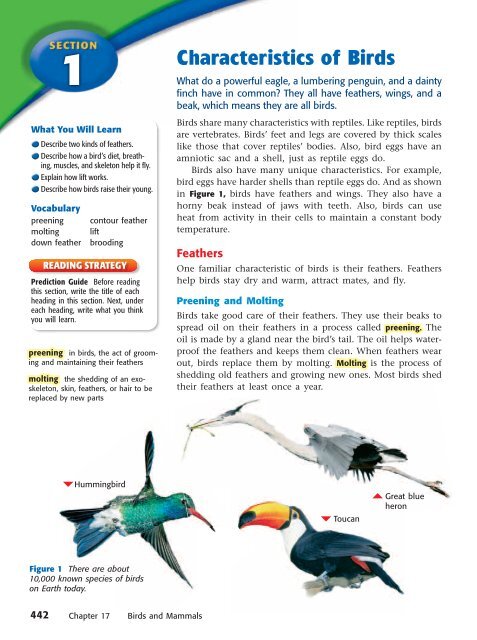
There are over 10,000 bird species worldwide, making birds one of the most diverse animal groups. They live on every continent, from the Arctic to the Antarctic.
Birds adapt to many environments:
- Penguins are adapted for cold and swimming.
- Hummingbirds have fast wings for hovering and feeding on nectar.
- Vultures can eat carrion without getting sick.
- Swifts spend almost their whole lives in the air.
This diversity is possible because of their flexible bodies, intelligence, and ability to change behavior or appearance over time.
Bird Diversity By Habitat
Here’s a look at bird diversity in different habitats:
| Habitat | Common Bird Types | Special Adaptations |
|---|---|---|
| Forest | Woodpeckers, Owls, Jays | Strong feet, camouflage |
| Wetlands | Herons, Ducks, Geese | Webbed feet, long bills |
| Desert | Roadrunners, Larks | Water conservation, heat tolerance |
| Grassland | Quails, Hawks | Strong legs, fast running/flying |
Communication And Social Structure
Birds use many sounds and signals to communicate. Songs help birds claim territory and attract mates. Calls can warn of danger or help flock members stay together.
Some birds, like parrots, have complex social groups. Others, like hawks, are solitary. Social structure depends on the species and environment.
Birds also use body language—like raising feathers, spreading wings, or dancing—to send messages.
Migration: Journeys Across The World
One of the most impressive bird behaviors is migration. Each year, billions of birds travel long distances to find food and suitable breeding sites.
- Arctic Tern: Flies over 70,000 km each year between the Arctic and Antarctic.
- Bar-headed Goose: Flies over the Himalayas at altitudes above 7,000 meters.
- Swallows: Cross deserts and oceans during migration.
Migration is risky and uses a lot of energy, but it allows birds to survive where food is only available part of the year.

Evolution And Fossil Record
Birds are descendants of dinosaurs. The oldest known bird fossil is Archaeopteryx, which lived about 150 million years ago. It had feathers and wings, but also teeth and a long tail.
Modern birds evolved to fill many different roles in nature. Their fossil record helps scientists learn about evolution and how birds survived events like the asteroid that killed the dinosaurs.
To learn more about bird evolution, visit the Wikipedia Bird page.
Two Insights Beginners Usually Miss
- Birds are not just about flying. Some birds, like ostriches and kiwis, cannot fly at all. They have adapted to run, swim, or even dig instead. Flightlessness has evolved in birds many times, often on islands where there are few predators.
- Feather color is not always about beauty. The bright colors seen in many birds are often signals to other birds, not just for humans to enjoy. Dull colors help females hide from predators, especially when nesting, while males are often more colorful for courtship.
Common Mistakes When Identifying Birds
- Assuming all flying animals are birds: Bats and some insects fly, but do not have feathers or beaks.
- Ignoring leg and bill shape: These features can be more helpful than color for identification.
- Believing all birds sing: Many birds, especially in the crow family, call but do not sing complex songs.
Birds And Humans
Birds have been part of human culture for centuries. They are symbols of freedom, beauty, and even wisdom. People keep birds as pets, use them for food, and study them for scientific research.
Birds also play vital roles in nature:
- Pollination: Hummingbirds pollinate flowers.
- Seed dispersal: Many birds spread seeds after eating fruit.
- Pest control: Birds eat insects and rodents.
Protecting birds means helping whole ecosystems stay healthy.
Frequently Asked Questions
What Is The Main Characteristic That Makes A Bird A Bird?
The most unique feature is feathers. All birds have them, and no other living animal does. Feathers help with flight, warmth, and communication.
How Do Birds Differ From Mammals?
Birds lay hard-shelled eggs and have beaks instead of teeth. They also have hollow bones and feathers, while mammals have hair or fur and mostly solid bones.
Why Do Some Birds Not Fly?
Flightless birds, like ostriches and penguins, evolved in places where flying was not needed. They developed strong legs for running or swimming instead. Sometimes, lack of predators on islands allowed flightless birds to survive.
How Do Birds Keep Warm In Cold Weather?
Birds use feathers to trap body heat, and many fluff them up in the cold. They also have a high metabolic rate, which helps generate heat. Some birds huddle together or tuck their heads under their wings to reduce heat loss.
How Smart Are Birds Compared To Other Animals?
Some birds are very intelligent. Crows and parrots can use tools, solve puzzles, and even learn words. Bird intelligence is similar to that of some mammals, like monkeys and dolphins.
Birds are much more than just flying animals. Their unique features and fascinating behaviors make them a key part of our world. By understanding what makes a bird a bird, we can better appreciate the role they play in nature and why it is important to protect them for future generations.