How Do Scientists Study Birds?
Birds capture human curiosity like few other animals. Their bright colors, complex songs, and incredible migrations inspire scientists to ask many questions. How do they find their way across continents? Why do some species sing at dawn while others remain silent? To answer these mysteries, researchers use many methods—some simple, some very advanced. Studying birds, or ornithology, is more than just watching them fly. It involves careful planning, specialized tools, and sometimes even teamwork across countries.
This article explains how scientists study birds in detail. You’ll learn about fieldwork, tracking technology, genetics, and the hidden challenges researchers face. Whether you want to become a bird scientist or just enjoy birds in your backyard, understanding these methods will give you a new appreciation for both the birds and the people who study them.
Observing Birds In The Wild
The most basic way to study birds is to watch them in their natural habitat. Scientists call this field observation. It sounds simple, but it requires patience, skill, and sometimes luck. Researchers visit forests, wetlands, cities, or deserts with binoculars, notebooks, and cameras. They look for bird behaviors like feeding, mating, nesting, or flying.
One advantage of field observation is that birds are seen without interference. Scientists can note details like which plants birds prefer, how they interact with other species, and how weather affects their activity. Sometimes, researchers use bird hides—small shelters that hide humans—so birds act naturally without fear.
A non-obvious challenge is observer bias. If a scientist expects to see a rare bird, they might mistake a common one for it. To reduce this, researchers often work in pairs and compare notes. They may also use sound recordings to confirm which birds are present, especially in dense forests where visibility is poor.
Bird Banding And Tagging
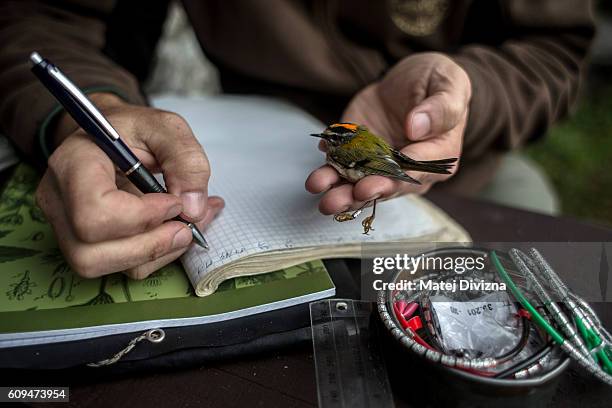
To study individual birds, scientists often use bird banding (or ringing). This involves gently catching a bird, placing a small, numbered ring around its leg, and releasing it. If the bird is seen or caught again, researchers can learn about its movements, lifespan, and habits.
Bird banding helps answer questions like:
- How far do birds migrate?
- Do they return to the same place each year?
- How long do they live in the wild?
Banding is done using special nets called mist nets. These are very fine and nearly invisible to birds. Once caught, birds are carefully measured and weighed. Scientists record details such as age, sex, wing length, and sometimes take a small feather sample for later study.
More advanced tags include colored rings (visible from a distance) or even electronic trackers. However, scientists must always ensure that tags are light and safe for the bird. A common mistake beginners make is using heavy tags, which can harm the bird or change its behavior.
Tracking Bird Movements
Understanding where birds go is a major goal in ornithology. Birds can travel thousands of kilometers, crossing mountains, oceans, and borders. To follow them, scientists use several tracking technologies.
Radio And Satellite Tracking
- Radio transmitters: Small devices attached to a bird send radio signals. Scientists use antennas to follow the signals and locate the bird. This method works well for local movements but has limited range.
- Satellite tracking: Tiny satellite tags send signals directly to satellites in space. Researchers can track birds across continents, even oceans. However, satellite tags are expensive and usually used only on larger birds.
Gps Loggers
GPS loggers record a bird’s exact location several times a day. The data are stored on the tag and must be collected later, usually by recapturing the bird. This gives detailed maps of migration routes and stopover sites.
Geolocators
Geolocators are very light devices that record daylight levels. By measuring sunrise and sunset times, scientists can estimate where the bird has traveled. Geolocators are useful for small songbirds that cannot carry heavy tags. However, the location estimates are less precise than GPS.
Here’s a comparison of common bird tracking devices:
| Device | Weight | Range | Data Accuracy | Cost |
|---|---|---|---|---|
| Radio Transmitter | Very light | Up to 20 km | High (local) | Low |
| GPS Logger | Light | Global (must recapture) | Very High | Medium |
| Satellite Tag | Heavier | Global (real-time) | Very High | High |
| Geolocator | Very light | Global (must recapture) | Medium | Medium |
A less obvious insight: Scientists sometimes combine these tools. For example, they may use GPS loggers for precise routes and geolocators on very small birds to balance weight and data needs.
Studying Bird Songs And Calls
Birds use sounds to attract mates, mark territory, and warn of danger. Understanding these sounds helps scientists learn about bird communication and behavior.
Sound Recording
Researchers use directional microphones and audio recorders to capture bird songs in the field. These devices can record sounds that humans cannot hear well, such as high-pitched calls or distant noises. The recordings are analyzed using special software to visualize the sound patterns, called sonograms.
Song Analysis
By comparing sonograms, scientists can:
- Identify species by their unique songs
- Study how songs change in different places (dialects)
- Discover how young birds learn songs from adults
One non-obvious method is playback experiments. Scientists play recorded bird songs through speakers to see how birds respond. This can reveal how they defend their territory or choose mates. However, care must be taken not to stress the birds.
Collecting Physical And Genetic Data
To understand bird health, evolution, and relationships, scientists often need more than just observations. They collect physical and genetic data.
Measuring And Sampling
When banding or capturing birds, researchers measure:
- Weight
- Wing, tail, and beak length
- Fat reserves
- Age and sex (if possible)
They may also collect tiny samples:
- A feather for DNA or chemical analysis
- A drop of blood for health studies
- A claw clipping (for some tests)
These samples are often used in laboratories to study genetics or exposure to pollutants.
Genetic Studies
Modern science allows researchers to examine bird DNA. This helps answer questions like:
- Are two similar birds really the same species?
- How are different bird populations related?
- Has a bird inherited resistance to disease?
One practical example is using DNA to solve bird strikes at airports. By analyzing feathers left on planes, scientists can identify which species are involved and suggest ways to reduce risks.
Using Cameras And Video In Research
Technology has transformed bird research with remote cameras and video recording. These methods capture information that humans would miss.
Nest Cameras
Scientists install small cameras near nests to watch how birds build nests, feed chicks, or defend against predators. Cameras can record for weeks without disturbing the birds. This gives data on:
- How often parents visit the nest
- What food is brought
- How chicks grow and behave
Motion-triggered Cameras
In remote or dangerous places, motion-triggered cameras help study rare or shy birds. The camera records when a bird moves in front of it, capturing images of behavior that would otherwise go unnoticed.
Drones And Aerial Photography
Drones offer new ways to study birds from above. They can count birds in large colonies, check nest sites on cliffs, or map habitats. However, drones must be used carefully to avoid scaring birds.
Here’s a quick comparison of visual observation tools:
| Tool | Main Use | Advantages | Limitations |
|---|---|---|---|
| Nest Camera | Monitor nests | Continuous data, low disturbance | Limited view, equipment costs |
| Motion Camera | Record rare events | Works in remote areas | May miss fast events |
| Drone | Aerial surveys | Large area coverage | Possible disturbance |
Studying Bird Populations And Communities
Understanding a single bird is useful, but many questions require studying entire populations or communities.
Surveys And Counts
Scientists perform bird surveys to estimate how many birds live in an area. Common survey types include:
- Point counts: Standing in one spot and counting all birds seen or heard for a set time.
- Transect walks: Walking a line and recording birds along the way.
- Aerial counts: Counting birds from planes or drones, useful for large colonies.
Accuracy matters. For example, birds hiding in thick bushes may be missed. To improve results, surveys are repeated at different times and under various weather conditions. Sometimes, citizen science projects like the Christmas Bird Count help collect massive amounts of data.
Demographic Studies
Population studies also track:
- Birth and death rates
- Migration timing
- Survival rates of young birds
This information is vital for conservation. If numbers drop quickly, scientists can look for causes like habitat loss, disease, or climate change.
A key insight: Combining surveys with genetic data can reveal if populations are connected or isolated, which affects their survival chances.
Laboratory Studies And Controlled Experiments
Fieldwork gives real-world data, but sometimes scientists need to test ideas in controlled settings. Laboratory studies and aviary experiments allow researchers to isolate specific factors.
Behavioral Experiments
In aviaries (large cages), scientists can test:
- How birds choose mates
- How they learn songs
- How they solve problems or use tools
This control helps answer questions that are impossible to test in the wild. For example, researchers may change the color of food to see if birds prefer certain colors, or play different songs to test learning.
Physiology Studies
Laboratory studies can measure:
- Metabolism (how much energy birds use)
- Responses to temperature changes
- Effects of new diseases or chemicals
These studies help predict how birds will cope with climate change or new threats.
A practical example: Scientists have discovered how some birds survive cold winters by lowering their body temperature at night—a behavior called torpor—through lab measurements.
Citizen Science And Public Involvement
Bird science is not limited to professionals. Citizen science projects involve ordinary people in research. With millions of birdwatchers worldwide, this creates huge datasets and helps scientists cover more ground.
Popular Citizen Science Projects
- EBird: People enter bird sightings online, creating a global map of bird distributions.
- Great Backyard Bird Count: Participants count birds in their gardens for a few days each year.
- NestWatch: Volunteers monitor nests and report data.
These projects provide valuable information on bird movements, population trends, and even the effects of climate change.
A hidden benefit: Citizen science increases public awareness and support for bird conservation. It also helps scientists detect rare events, such as sudden arrivals of new species.
Bird Conservation And Policy Influence
Scientific studies are the foundation of bird conservation. Data on bird numbers, migrations, and threats help shape laws and protect critical habitats.
Identifying Threats
Researchers use their findings to pinpoint:
- Habitat loss (e.g., deforestation)
- Pollution (e.g., pesticides, plastics)
- Climate change impacts
- Invasive species
For example, studies have shown that millions of birds die each year from window collisions. This data supports new building designs with bird-safe glass.
Creating Protected Areas
Migration tracking helps identify important stopover sites. Governments and organizations can create protected areas based on this information, ensuring birds have safe places to rest and breed.
Advocacy And Education
Scientists often work with policymakers, landowners, and the public. They explain why birds matter and how everyone can help. Outreach materials, school programs, and media stories spread the message.
A crucial point: Science-based decisions are more likely to succeed and be accepted by the public and authorities.
Challenges And Ethical Considerations
Studying birds is not always easy. Researchers face many challenges, both practical and ethical.
Weather And Terrain
Birds live in all environments, from jungles to arctic tundra. Fieldwork can be exhausting, with long hours in heat, cold, or rain. Sometimes, dangerous animals or tough terrain add risks.
Minimizing Disturbance
Scientists must ensure their presence does not harm birds. This means using light tags, minimizing handling time, and avoiding nests during sensitive periods. Ethics committees review research plans to protect animal welfare.
Data Management
Modern research produces huge amounts of data—photos, sounds, GPS points, DNA sequences. Organizing and analyzing this information takes time and expertise. Data sharing is also important, so others can use the results for new studies.
Funding And Resources
Research is often expensive. Equipment, travel, and laboratory work require funding from governments or organizations. Sometimes, lack of resources limits the scope of studies.
A less obvious challenge: Political instability or wars can stop research in important areas, making global bird conservation harder.
How Bird Study Methods Have Changed Over Time
Bird study has changed dramatically over the past century. Early ornithologists relied on observation and collecting specimens. Today, technology allows scientists to answer questions that once seemed impossible.
Past Methods
- Shooting birds to examine them (common before 1950s)
- Simple observation with binoculars
- Drawing birds by hand
Modern Advances
- Miniaturized electronic tags and cameras
- Genetic sequencing
- Internet-based citizen science
- Remote sensing (satellites, drones)
These advances have led to discoveries such as how bar-tailed godwits fly nonstop from Alaska to New Zealand—over 11,000 kilometers in a single flight.
However, some traditional skills, like identifying birds by sound or subtle markings, remain essential. The best bird scientists combine old and new methods.

Comparing Bird Study To Other Animal Research
Studying birds is different from researching mammals, insects, or fish. Birds are highly mobile, visible, and vocal. They are easier to watch than many mammals but harder to keep in captivity.
Here’s a quick comparison:
| Animal Group | Ease of Observation | Tracking Difficulty | Common Methods |
|---|---|---|---|
| Birds | Medium to High | Medium | Observation, tagging, sound recording |
| Mammals | Low to Medium | High | Camera traps, GPS collars |
| Fish | Low | Very High | Tagging, sonar |
| Insects | Low | Low | Netting, marking |
Birds’ ability to fly long distances makes them excellent indicators of environmental health. Changes in bird populations often signal wider ecological problems.
The Future Of Bird Science
As technology improves, bird studies will become even more precise and wide-ranging. Miniature tags, better cameras, and advanced genetics will reveal new secrets. Climate change, habitat loss, and new diseases make research more urgent than ever.
One exciting trend is the use of machine learning to analyze bird songs and images. Computers can now identify species from millions of recordings, helping scientists track changes in real time.
International cooperation is also growing. Projects like the Migratory Shorebird Project involve teams from many countries, sharing data and solutions.
But some questions remain. How will birds adapt to a warming planet? Can we protect enough habitat for the most threatened species? The answers depend on both science and public action.

Frequently Asked Questions
How Do Scientists Catch Birds Without Hurting Them?
Scientists use special tools like mist nets or box traps that gently hold birds without injury. They check the nets often and handle birds carefully to minimize stress. All research must follow strict ethical guidelines approved by animal care committees.
Why Do Scientists Put Rings Or Bands On Birds?
Bird bands are used to identify individual birds. This helps researchers track movements, lifespan, and behavior over time. If a banded bird is seen or caught again, valuable information is gained. Bands are very light and do not harm the bird.
Can Scientists Follow Small Birds On Long Migrations?
Yes, with new technology. Devices like geolocators and tiny GPS loggers can be attached even to small songbirds. While earlier only large birds could carry trackers, advances now allow tracking of birds weighing just a few grams.
How Do Scientists Know What Birds Eat?
Researchers study bird diets by:
- Watching feeding behavior
- Examining stomach contents (from birds that died naturally)
- Analyzing droppings for seeds or insect parts
- Using DNA analysis of food remains
Each method gives different clues about diet and food preferences.
How Can Ordinary People Help Scientists Study Birds?
Anyone can contribute by joining citizen science projects like eBird or the Great Backyard Bird Count. Reporting bird sightings, monitoring nests, or even photographing birds helps build valuable data for research and conservation.
Birds connect us to nature and to science. Whether through careful observation, modern technology, or community projects, studying birds helps us understand and protect the world around us. If you want to learn more or join bird research projects, visit resources like the Cornell Lab of Ornithology for up-to-date information and opportunities.