
Are Birds Intelligent Animals?
When most people think of smart animals, they often picture dolphins, chimpanzees, or dogs. Birds rarely come to mind first. But in recent years, scientists have discovered that birds are not just clever — some are among the most intelligent animals on the planet.
From solving complex problems to using tools and even understanding language, birds continue to surprise researchers and birdwatchers alike.
The question “Are birds intelligent animals? ” opens the door to a fascinating world where crows outsmart children in puzzles, parrots remember hundreds of words, and pigeons can recognize faces. Bird brains may be small, but size isn’t everything. Let’s explore what makes birds so smart, how their intelligence compares to other animals, and why their abilities matter.
What Does Bird Intelligence Mean?
The word intelligence is not easy to define, even for humans. In animals, intelligence usually means the ability to solve problems, adapt to new situations, communicate, remember things, and use tools. For birds, these skills can look very different from mammals because their brains are built differently.
Birds have a brain structure called the pallium. This part of the brain is similar to the human cortex, which is responsible for thinking and planning. Recent studies show that the pallium in birds is highly developed, especially in species like crows and parrots. This allows some birds to do things that were once thought impossible for “bird brains.”
How Scientists Measure Bird Intelligence
Researchers use several methods to test how smart birds are. Here are a few common approaches:
- Problem-solving tests: Birds are given puzzles to solve, such as getting food out of a box using sticks.
- Memory challenges: Birds are tested to see how well they can remember locations or patterns.
- Social intelligence: Scientists study how birds interact with each other, cooperate, or even trick one another.
- Communication tests: These tests see if birds can learn words, sounds, or even symbols.
The results often show that some birds perform as well as, or better than, many mammals.
Birds With Exceptional Intelligence
Not all birds are equally smart. Some species stand out for their amazing abilities. Let’s look at a few of the world’s most intelligent birds.
Crows And Ravens
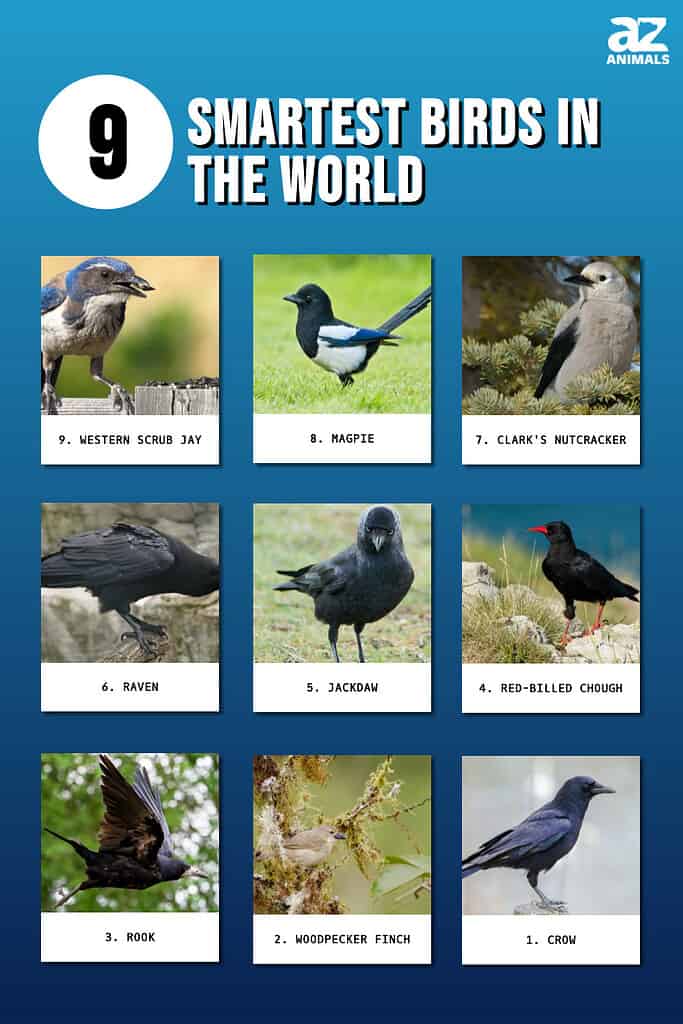
Crows and ravens belong to the corvid family, which also includes magpies and jays. These birds are famous for their cleverness.
- Tool use: New Caledonian crows can shape sticks into hooks to get insects out of tree bark. This is similar to how early humans used tools.
- Planning: Ravens have been shown to plan for the future, saving items they might need later.
- Puzzle solving: In experiments, crows have completed tasks that are as difficult as those given to 5- to 7-year-old children.
One famous example is Betty, a New Caledonian crow who bent a wire into a hook to retrieve a bucket of food — something she had never seen before.
African Grey Parrots
Parrots are also known for their intelligence, especially African grey parrots. These birds can:
- Learn and use human words: Alex, a famous African grey, could name colors, shapes, and count objects correctly.
- Understand concepts: Some parrots can understand the idea of “same” and “different.”
- Solve puzzles: They can solve simple locks and even work together to reach food.
African greys have been tested for their reasoning skills and have performed as well as small children in certain tasks.
Pigeons
Many people think of pigeons as simple city birds. But pigeons are surprisingly smart:
- Memory: Pigeons can remember hundreds of images for years.
- Recognition: They can recognize themselves in a mirror, and even tell apart different human faces.
- Navigation: Homing pigeons can travel thousands of kilometers and still find their way home.
Pigeons have even been used in military communication because of their reliable navigation skills.
Kea
The kea is a large parrot from New Zealand. It is known for its playful and curious nature.
- Problem solving: Keas can solve puzzles with multiple steps and learn from each other.
- Teamwork: These parrots sometimes work in pairs to get food, showing signs of cooperation.
- Play: Keas are one of the few non-mammals that play games for fun, not just for survival.
Keas have been observed opening trash bins and car doors to look for food, which shows their adaptability.
Jays
Jays are also part of the corvid family and are known for their memory.
- Food caching: Jays hide food in hundreds of places and remember each spot for months.
- Planning: They can change their hiding strategies if they think another bird is watching.
- Deception: Some jays pretend to hide food in one place and move it later to avoid thieves.
Their ability to plan and deceive is similar to what we see in primates.
Unique Types Of Bird Intelligence
Birds show their intelligence in many ways that are different from mammals.
Tool Use And Creation
Using tools was once thought to be a human trait, but birds like crows and woodpecker finches make and use tools daily. For example, the woodpecker finch uses cactus spines to pull insects from tree holes. Some birds even shape tools for specific tasks, which shows advanced thinking.
Communication And Language
Parrots and songbirds have complex vocal abilities. Some can learn hundreds of sounds and even use them to “talk. ” Parrots like Alex have used words meaningfully, not just by copying. Songbirds change their songs to fit their social group, similar to human dialects.
Memory And Navigation
Migratory birds remember routes that cover thousands of kilometers. Clark’s nutcrackers can remember up to 30,000 hiding places for their food. Homing pigeons use Earth’s magnetic field, the sun, and landmarks to navigate — skills that would challenge even humans.
Social Intelligence
Birds like jackdaws and magpies understand social rules in their groups. They can recognize individuals, remember past interactions, and even punish cheaters. Some birds, like ravens, understand what other birds know or see, which is called “theory of mind. ”
Comparing Bird Intelligence To Mammals
It’s natural to compare bird intelligence with that of mammals. While their brains look different, they solve similar problems in many ways.
| Skill | Birds | Mammals |
|---|---|---|
| Tool use | Crows, parrots, woodpecker finches | Chimpanzees, dolphins, elephants |
| Communication | Parrots, songbirds | Whales, primates |
| Problem-solving | Crows, kea, jays | Rats, dogs, apes |
| Memory | Clark’s nutcracker, pigeons | Squirrels, elephants |
| Self-recognition | Magpies, pigeons | Great apes, dolphins |
This comparison shows that birds are just as capable as many mammals. In some tasks, birds even outperform primates.
Surprising Insights About Bird Intelligence
Some findings about bird intelligence are not obvious, even to many experts.
Small Brains, Big Power
It’s easy to think that a small brain means low intelligence. But birds pack a lot of neurons into a small space. For example, parrots and songbirds have as many neurons in their brains as monkeys do. This efficient design allows birds to be smart without large, heavy heads.
Learning By Watching
Many birds learn from watching others, not just from trial and error. This is called social learning. For example, young crows learn how to use tools by watching adults. Some birds even copy new behaviors from rivals, not just their own group.
Evolution Of Bird Intelligence
Why did birds become so smart? Scientists think intelligence helped birds survive in changing environments. Birds that could solve problems or remember food locations were more likely to live and reproduce.
Social life also played a role. Birds that live in groups need to keep track of relationships, remember who is a friend or enemy, and sometimes work together. These social skills are linked to intelligence in both birds and mammals.
Migratory birds needed good memory and navigation skills to travel long distances and return home. All these challenges pushed bird brains to grow smarter over time.
Famous Experiments In Bird Intelligence
Several scientific studies have changed how we view birds. Here are three classic experiments:
- Aesop’s Fable Test: In this test, crows were shown a tube with floating food and water. They dropped stones into the tube to raise the water level and get the food, just like in the old fable. This showed that crows understand cause and effect.
- Mirror Test: Magpies were tested to see if they could recognize themselves in a mirror. Some birds tried to remove marks on their bodies after seeing them in the mirror, suggesting self-awareness.
- Alex the Parrot: Alex was an African grey parrot who learned to name over 100 objects, colors, and shapes. He could answer questions about categories and even ask for things using words.
These studies proved that birds can think, plan, and even reflect on themselves.
Bird Intelligence In Daily Life
Wild birds use their intelligence in many ways to survive. Here are some real-world examples:
- Crows drop nuts on roads for cars to crack open, then wait for the traffic light to turn red before collecting the food.
- Parrots use their beaks and feet to open tough seeds and fruits, showing complex coordination.
- Pigeons have helped humans by carrying messages during wars, thanks to their navigation skills.
- Kea open backpacks, trash bins, and even car doors in search of food, sometimes working together.
These everyday examples show that bird intelligence is not just for science labs — it’s a crucial part of their lives.
Myths And Misunderstandings About Bird Intelligence
There are many myths about birds:
- Myth: “Bird brain” means stupid.
Fact: This old insult is not true. Bird brains are small but very efficient.
- Myth: Only parrots can talk.
Fact: Some crows, starlings, and mynah birds can also mimic human speech.
- Myth: All birds are equally smart.
Fact: Intelligence varies widely between species. Crows and parrots are much smarter than chickens or pigeons.
Understanding these facts helps people see birds in a new light.
How Bird Intelligence Helps Humans
Birds’ intelligence is not just interesting — it’s useful for humans, too.
- Research models: Birds are used to study brain function, learning, and memory. This research can help us understand human brains.
- Environmental indicators: Smart birds can adapt to changes in their habitats, but when even clever birds struggle, it’s a warning sign for the environment.
- Inspiration for technology: Bird navigation has inspired GPS and drone technology. Their efficient brains are also studied by engineers to build better robots.
By learning from birds, we improve our understanding of the natural world and ourselves.
Bird Intelligence Across The World
Bird intelligence is not limited to one continent or habitat. Here’s a comparison of smart birds from different regions:
| Region | Smartest Bird Species | Famous Ability |
|---|---|---|
| North America | Clark’s Nutcracker | Remembers thousands of food caches |
| Europe | Magpie | Self-recognition in mirrors |
| Asia | Eurasian Jay | Advanced planning and deception |
| Australasia | Kea | Problem solving and teamwork |
| Africa | African Grey Parrot | Language and reasoning |
| Oceania | New Caledonian Crow | Tool making and use |
This variety shows that high intelligence evolved in birds all over the world, often in response to different challenges.
Challenges In Studying Bird Intelligence
Studying bird intelligence is not always easy. There are some challenges:
- Different senses: Birds rely more on vision and hearing than smell or touch, unlike many mammals.
- Short attention spans: Some birds are easily distracted, making testing difficult.
- Human bias: Researchers sometimes design tests that fit mammal thinking, not bird thinking, which can underestimate bird intelligence.
It is important for scientists to create fair tests that match how birds see and interact with their world.
What Beginners Often Miss About Bird Intelligence
Many people new to the topic believe that intelligence is only about language or tool use. But for birds, intelligence also means:
- Adapting to new foods and dangers: Urban crows and pigeons quickly learn to live around humans, cars, and cities.
- Complex social lives: Birds like ravens and magpies remember friends and rivals for years, which affects their choices every day.
Beginners often miss how important flexibility and social memory are for birds.
:strip_icc()/a-jenday-conure--aratinga-jandaya--perched-in-a-tree--also-known-as-jandaya-parakeet-is-a-small-neotropical-bird-found-in-northeastern-brazil--1271574400-b0036047517a4709ae998813fd790932.jpg)
The Future Of Bird Intelligence Research
Scientists are only beginning to understand how smart birds really are. New tools like brain imaging and genetic studies are revealing more every year. There are still many questions:
- How do bird brains create complex behaviors with fewer neurons?
- Can birds teach each other new skills across generations?
- What can we learn from birds to improve artificial intelligence?
As research continues, we will likely find that birds are even smarter than we imagine today.
Frequently Asked Questions
How Do Scientists Know If Birds Are Intelligent?
Scientists use tests like problem-solving puzzles, memory challenges, and communication tasks to measure bird intelligence. They also watch how birds behave in the wild, such as using tools or working together.
Are All Birds Equally Smart?
No, intelligence varies a lot among bird species. Crows, parrots, and jays are among the smartest, while some birds like chickens have simpler behaviors.
Can Birds Understand Human Language?
Some birds, especially parrots, can learn to understand and use human words. Famous parrots like Alex could answer questions and even ask for things. However, not all birds can do this.
Do Birds Have Good Memories?
Yes, many birds have excellent memories. For example, Clark’s nutcrackers can remember where they hide thousands of seeds for months. Pigeons can recognize faces and remember images for years.
Where Can I Learn More About Bird Intelligence?
You can read detailed articles and research on the topic from trusted sources, such as the Wikipedia page on avian intelligence.
Birds are not just creatures of instinct. Many are creative problem solvers, skilled communicators, and social thinkers. Next time you see a crow, parrot, or even a city pigeon, remember: you might be looking at one of the world’s most intelligent animals. With more research, who knows what other surprises the bird brain will reveal?