
The world of elk is both fascinating and complex. For many people, the word “elk” brings to mind a large, antlered animal roaming forests in North America. But the reality is more layered. Elk are not just one animal, but a group with rich diversity, history, and even controversy around their classification.
If you’ve ever wondered how many species of elk exist, and what makes each one unique, you’re about to get clear, detailed answers.
What Is An Elk?
The term elk can mean different things depending on where you are in the world. In North America, elk refers to a large deer species known as Cervus canadensis. In Europe, the word “elk” often means what North Americans call moose. For this article, we are focusing on the North American meaning: members of the genus Cervus known as elk or wapiti.
Elk are part of the Cervidae family, which also includes deer, reindeer (caribou), and moose. These animals play important roles in their ecosystems and have a long history with humans—through hunting, culture, and conservation.
The Science Of Elk Classification
To answer how many species of elk there are, we need to look at taxonomy—the science of naming and grouping living things. Scientists have debated elk classification for years. Some classify elk as one species with several subspecies; others split them into more than one species.
Modern genetic studies add more detail, but sometimes more confusion.
Most experts today agree that there is one main elk species, Cervus canadensis, with several subspecies. However, some older sources and a few scientists still consider the European red deer (Cervus elaphus) and the North American elk as separate species. For this article, we’ll focus on the most widely accepted view: one species of elk (Cervus canadensis) with several living and extinct subspecies.

How Many Species And Subspecies Of Elk Are There?
There is one main species of elk, Cervus canadensis. Within this species, there are six recognized living subspecies and four extinct subspecies. Some sources may combine or split these further, but this is the most widely accepted breakdown today.
Living Subspecies Of Elk
Below are the six major living subspecies of elk, each with unique features and native ranges.
1. Rocky Mountain Elk (cervus Canadensis Nelsoni)
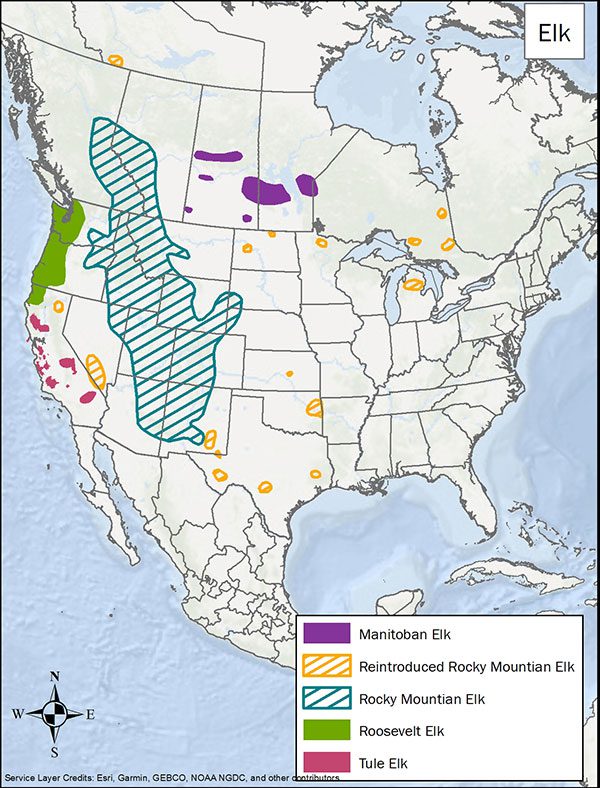
This is the most common elk in North America, especially in the Rocky Mountains. Rocky Mountain elk have large bodies, light-colored rumps, and impressive antlers. They are found from Canada to New Mexico, and have been successfully reintroduced in states like Kentucky and Pennsylvania.
2. Roosevelt Elk (cervus Canadensis Roosevelti)
The Roosevelt elk is the largest of all elk subspecies by body mass. Found mainly along the Pacific Coast—from northern California through Oregon, Washington, and into British Columbia—they prefer dense rainforests. Their antlers are shorter but heavier than other elk.
3. Tule Elk (cervus Canadensis Nannodes)
Native to central California, the tule elk is the smallest living elk subspecies. They nearly went extinct in the 1800s, with only a handful left, but conservation efforts have helped their population recover. Tule elk have adapted to open grasslands and marshy areas.
4. Manitoban Elk (cervus Canadensis Manitobensis)
As the name suggests, Manitoban elk are found in the Canadian prairies and northern states like North Dakota and Minnesota. They are larger than Rocky Mountain elk but have smaller antlers. Their range is mostly open forests and grasslands.
5. Eastern Elk (cervus Canadensis Canadensis) (extinct In The Wild, Reintroduced)
Historically, eastern elk lived across the eastern United States and southern Canada. Overhunting and habitat loss wiped out the original population by the late 1800s. However, elk from other subspecies have been reintroduced to the region, especially the Rocky Mountain elk, to fill the ecological role of the extinct eastern elk.
6. Alaskan Elk (cervus Canadensis Alascensis)
This is a lesser-known group, mainly found on some Alaskan islands where they were introduced. Their status as a separate subspecies is debated, but they are often included in lists of elk diversity.
Extinct Subspecies Of Elk
Four main subspecies of elk are considered extinct, mostly due to overhunting and habitat changes. These extinctions have shaped the distribution of elk today.
- Eastern Elk (Cervus canadensis canadensis): Native to the eastern US and Canada, extinct by 1877.
- Merriam’s Elk (Cervus canadensis merriami): Lived in the southwestern US; extinct by the early 1900s.
- Caspian Elk (Cervus canadensis bactrianus): Once found around the Caspian Sea region, extinct by the mid-20th century.
- Irish Elk (Megaloceros giganteus): Not a true elk, but worth mentioning. This giant deer lived in Europe and Asia until about 7,700 years ago. Its enormous antlers inspired many legends.
Elk Vs. Red Deer: A Common Source Of Confusion
Elk and red deer are closely related, both in the Cervus genus. In Europe and Asia, Cervus elaphus (red deer) fills a similar ecological role. For a long time, scientists thought they were the same species. Recent genetic studies show they are different, but still closely related. In some places, elk and red deer can interbreed, making the line less clear.
Here’s a comparison of the main features:
| Feature | Elk (Cervus canadensis) | Red Deer (Cervus elaphus) |
|---|---|---|
| Native Range | North America, East Asia | Europe, West Asia, parts of North Africa |
| Body Size | Larger (males up to 700 lb / 320 kg) | Smaller (males up to 500 lb / 225 kg) |
| Vocalization | Bugling call | Roaring call |
Where Are Elk Found Today?
Elk once roamed much of the Northern Hemisphere. Today, their range is more limited. Wild elk are found mainly in:
- Western North America (Rocky Mountains, Pacific Northwest, Canada)
- Small populations in the eastern US (reintroduced)
- Parts of Asia (Siberia, Mongolia, China)
- Isolated populations in New Zealand and Argentina (introduced for hunting)
Elk adapt well to forests, grasslands, and even mountains. However, they need large areas to roam and graze. That’s why conservation and land management are so important for their survival.
How Do Elk Subspecies Differ?
Each elk subspecies shows unique adaptations. These differences help them survive in their specific environments.
| Subspecies | Main Habitat | Body Size | Notable Features |
|---|---|---|---|
| Rocky Mountain Elk | Mountains, forests | Large | Long antlers, migratory |
| Roosevelt Elk | Coastal rainforests | Largest by mass | Thick body, short antlers |
| Tule Elk | Grasslands, marshes | Smallest | Light body, small antlers |
| Manitoban Elk | Prairies, open woods | Large | Wide body, shorter antlers |
Some differences are easy to see, like antler shape and body mass. Others are less obvious, such as migration patterns or resistance to local diseases.
Why Do Elk Subspecies Matter?
Understanding elk diversity is not just about names. It’s about preserving unique adaptations and keeping ecosystems healthy. For example, the tule elk is the only elk adapted for California’s grasslands. If it goes extinct, that adaptation is lost forever.
Elk subspecies also show us how animals respond to changing climates, hunting, and land use. This information can guide conservation efforts for many other species.
Conservation Successes And Challenges
Elk populations were once in danger across North America. Overhunting, habitat loss, and diseases brought them near extinction in many places. Thanks to hunting regulations, reintroduction programs, and protected lands, elk have made a strong comeback.
A few key facts:
- By 1900, only about 40,000 elk remained in the US. Today, there are over 1 million.
- The tule elk dropped to fewer than 30 animals in the 1870s. Now, there are over 5,000.
- Reintroduction programs have brought elk back to places like Kentucky, Pennsylvania, and the Great Smoky Mountains.
However, challenges remain. Habitat loss, disease (like chronic wasting disease), and conflicts with farming still threaten elk. Not all subspecies have recovered. For example, the original eastern elk is gone forever; its role is only partly filled by transplanted elk from the west.
Non-obvious Insights Most People Miss
- Subspecies boundaries are blurry: Elk subspecies often interbreed where their ranges meet, creating hybrid populations. So, the “lines” between subspecies are not always clear or fixed.
- Elk migration is crucial for survival: Some elk, like the Rocky Mountain elk, migrate hundreds of miles between winter and summer ranges. Blocking these routes with roads or fences can reduce elk numbers, even if the overall habitat looks healthy.
Elk In Culture And History
Elk have been a symbol of strength and wildness for thousands of years. Indigenous peoples hunted elk for food, clothing, and tools. Early European settlers relied on elk meat and hides. Today, elk are important for hunting, wildlife tourism, and as a symbol of healthy wilderness.
In some cultures, elk antlers were used in ceremonies, and elk images appear in ancient cave art. Even today, the sound of a bull elk bugling in autumn is a highlight for visitors to national parks.
The Future Of Elk
Protecting elk is about more than saving a single animal. It’s about keeping forests, grasslands, and the web of life healthy. As human development grows, elk need help to move safely between habitats and avoid new diseases. Conservation groups, hunters, and governments all play roles in this effort.
For more in-depth research and scientific details, you can visit the Wikipedia page on Elk.
Frequently Asked Questions
How Many Species Of Elk Are There?
There is one main species of elk, Cervus canadensis, according to most scientists. Within this species, there are six living subspecies and four extinct subspecies.
What Is The Difference Between Elk And Red Deer?
Elk (Cervus canadensis) are native to North America and parts of Asia, and are larger with different calls and antler shapes. Red deer (Cervus elaphus) are found in Europe and western Asia. They are closely related but considered separate species.
Where Can I See Elk In The Wild?
You can see wild elk in many western US states, Canadian provinces, and some reintroduced areas in the eastern US. National parks like Yellowstone and Rocky Mountain National Park are famous for elk viewing.
Are Any Elk Subspecies Endangered?
No living elk subspecies is considered endangered today, but their populations are closely monitored. Some, like the tule elk, have small populations and need ongoing protection.
Can Elk And Deer Breed Together?
Elk and deer are different species and cannot breed in the wild. However, elk can sometimes breed with red deer in captivity, producing hybrids known as “elk-red deer hybrids. ”
Elk continue to inspire and challenge us. Understanding their diversity is one step toward ensuring that future generations will still hear the haunting call of these great animals in wild lands.