
Every autumn and spring, people across the world look up and notice the same remarkable sight: groups of birds flying in a perfect V shape across the sky. This pattern is seen in many species, from large geese and pelicans to smaller shorebirds. For centuries, humans have wondered about the reason behind this synchronized flight formation. Is it just a random behavior, or does it serve a specific purpose? Modern science has uncovered fascinating answers, showing that the V formation is more than just beautiful—it is a clever and efficient strategy shaped by evolution.
Understanding why birds fly in a V shape reveals secrets about their survival, navigation, and social behavior. This article will explore the main reasons behind this unique formation, how it helps birds travel thousands of miles, and what we can learn from their teamwork.
We’ll also look at surprising scientific studies, real-world examples, and even how this knowledge is used in human technology. By the end, you’ll see the V shape not just as a symbol of migration, but as a masterpiece of nature’s engineering.
The Basics Of Bird Migration
Bird migration is one of the most impressive events in the natural world. Many birds travel from one part of the world to another, often covering thousands of kilometers. For example, the bar-tailed godwit can fly over 11,000 kilometers non-stop from Alaska to New Zealand. These journeys are not random; they are essential for survival. Birds migrate to find food, escape harsh climates, and breed in safe places.
But migration is not easy. Birds face strong winds, changing weather, and the danger of getting lost. They need to save as much energy as possible to survive these long trips. This is where the V formation comes in. By flying in this shape, birds turn a difficult journey into a more manageable one.
The Science Behind The V Shape
Aerodynamics And Energy Saving
One of the main reasons birds fly in a V formation is to save energy. When a bird flaps its wings, it creates air currents. The tips of the wings produce upwash, a rising current of air that gives a small lift. If another bird flies just behind and to the side of the first bird, it can ride this upwash and use less energy to stay in the air.
Think of it like riding a bicycle behind a friend. The person in front blocks the wind, making it easier for you to pedal. In the same way, birds take turns being at the front, where flying is hardest, then move back to rest in the easier positions.
This teamwork helps the whole group fly farther without getting as tired.
Real Data: How Much Energy Is Saved?
Studies have shown that birds in a V formation can save between 10% and 20% of their energy compared to flying alone. In one famous experiment, researchers put heart rate monitors on northern bald ibises flying in a V. They found the birds’ heart rates were lower when they flew in the right position, showing that they really did use less energy.
Communication And Coordination
The V shape is not only about saving energy. It also helps birds communicate and coordinate during flight. Each bird can see the leader and its neighbors, making it easier to stay together as a group. This reduces the risk of getting lost and helps the flock change direction quickly if needed.
In fog, rain, or low light, the V formation acts like a moving signal, helping birds keep track of each other. For young or less experienced birds, it’s a way to learn the route and flying technique by watching older birds.
Protection From Predators
Flying in a group can make birds less likely to be attacked by predators. When they stick together in a clear pattern, it’s harder for a predator to target one bird. The V formation also lets birds keep an eye on each other and spot danger early.
This safety in numbers is important, especially during long migrations over open land or water.
How The V Formation Works
Structure Of The V
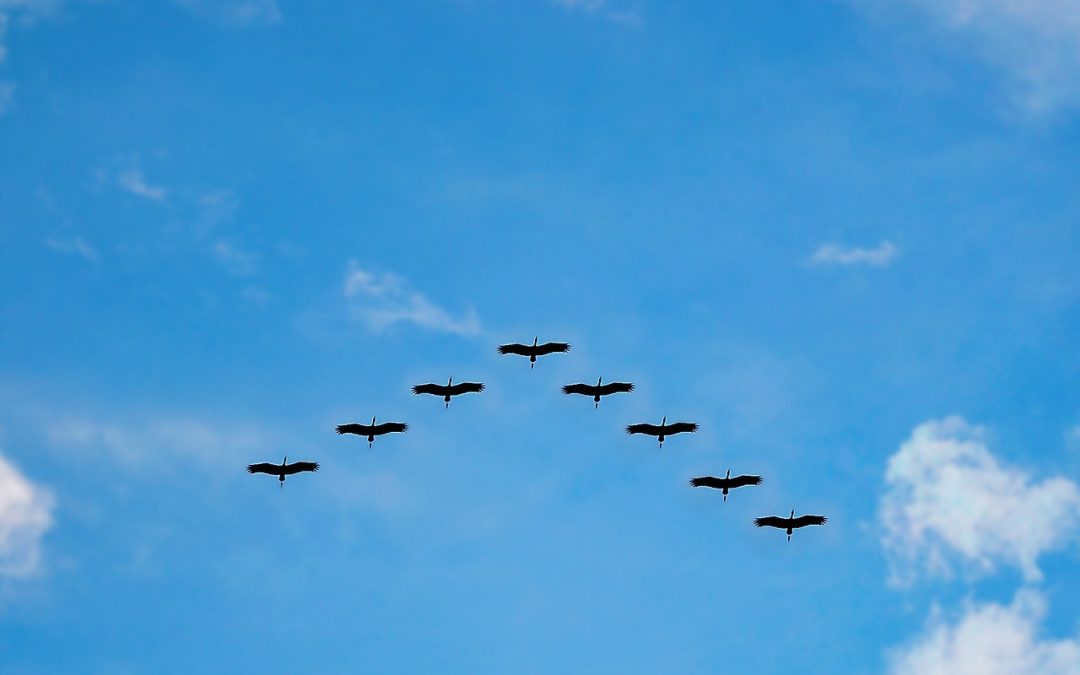
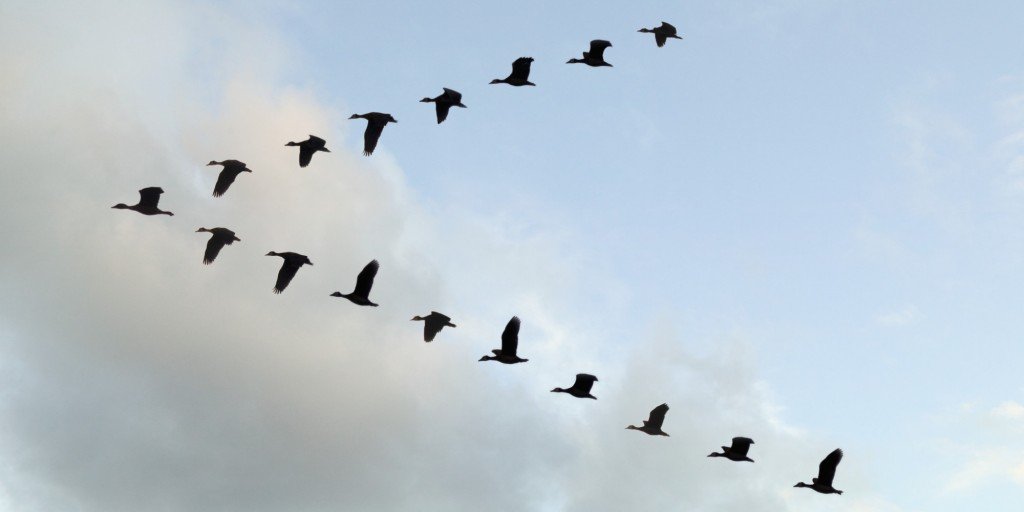
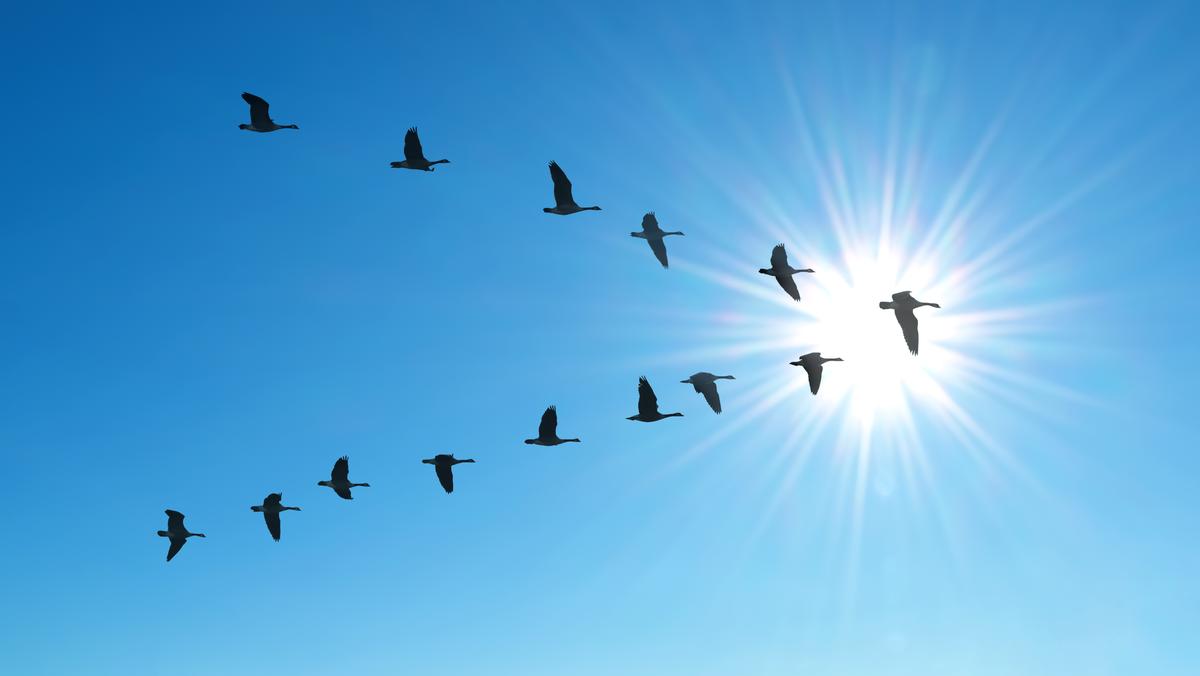
The V shape is not random. Usually, one bird leads at the point, and the others line up in two diagonal lines behind it. The angle of the V can change depending on the number of birds and the type of species.
Sometimes the formation looks like a wide V, sometimes more like a straight line.
The lead bird has the hardest job. It faces the full force of the wind and creates the upwash for others. After a while, the leader moves back, and another bird takes its place. This rotation keeps the flock moving efficiently.
Spacing And Position
Birds keep a specific distance from each other. If they get too close, their wings can bump. Too far away, and they lose the energy-saving benefit. Many species adjust their position every few seconds to stay in the best spot.
Here’s a simple comparison of how energy use changes with different positions in the V:
| Position in Formation | Relative Energy Used (%) | Benefit |
|---|---|---|
| Lead Bird | 100% | Breaks wind, hardest job |
| Second Row | 85-90% | Receives upwash, less effort |
| Middle Rows | 80-85% | Best energy savings |
| Rear of V | 85-90% | Some turbulence, still easier than front |
Taking Turns: Bird Teamwork
One non-obvious insight is that not all birds in the V are equal all the time. Stronger or more experienced birds often lead longer, while younger or weaker birds spend more time in the easier spots. Some birds are better at finding the best position, and there’s a silent cooperation happening in every flock.
Researchers have noticed that birds even seem to remember which individuals took the lead before, and sometimes they “repay” the favor by taking their turn. This kind of cooperation is rare in nature and shows how important the V formation is for survival.
Which Birds Fly In A V Shape?
The V formation is most famous in large, long-distance migrants, but it’s not limited to just one group. Here are some common examples:
- Geese (Canada geese, greylag geese)
- Ducks (mallards, pintails)
- Swans
- Pelicans
- Cranes
- Ibises
- Cormorants
- Shorebirds (some species during migration)
- Spoonbills
Not all birds migrate in V shapes. Smaller songbirds, for example, often migrate at night in loose flocks or even alone. The V formation works best for bigger birds with strong, steady wingbeats.
The Physics Of V Formation Flight
The Role Of Upwash And Downwash
When a bird flaps its wings, it pushes air down and out. Behind the wingtips, the air swirls up (upwash) on the outside and down (downwash) in the middle. By flying just to the side of the bird in front, a following bird can sit in the upwash and get a free lift.
This reduces the work their wings need to do.
The angle and timing matter. Birds have to flap their wings in sync with the bird ahead to get the most benefit. Scientists using GPS trackers and tiny sensors have found that birds can match their wingbeats to within a fraction of a second.
How Big Is The Effect?
The energy savings add up over long distances. For a flock flying 1,000 kilometers, a 15% saving could mean finishing the trip a day earlier or arriving with enough energy to escape predators.
Here’s a comparison of travel distance possible with and without V formation:
| Flight Style | Possible Distance (km) | Energy Used (approx.) |
|---|---|---|
| Solo Flight | 1,000 | High (100%) |
| V Formation | 1,150 | Lower (85-90%) |
Even a small gain in efficiency can make the difference between life and death for migrating birds.
Navigation And Learning
Using The V Shape For Guidance
Another important benefit is that the V formation helps birds navigate. The leader often knows the route and sets the direction. The followers can focus on keeping position and conserving energy. When the leader gets tired or unsure, another bird takes the lead. This way, the group always has a clear path.
Young birds learn from older ones by flying in the V. They observe how to adjust position, when to rest, and which way to go. This is especially important for species where the migration route is not entirely instinctive but partly learned.
Visual Signals And Group Movement
The V shape is easy to see from behind, making it simple for each bird to follow the group. If the leader turns, the whole V shifts smoothly. This is much harder in a random flock, where some birds might get lost in the crowd.
Social Dynamics Within The V
Leadership And Followership
Birds in the V formation are not just flying; they are communicating. Scientists have found that some birds “talk” to each other with special calls during migration. These calls can mean “speed up,” “slow down,” or “danger ahead. ” The V shape keeps the group close enough for these signals to work.
Leadership is often shared. In some species, each bird spends about the same amount of time at the front. In others, a few strong birds do most of the leading. This sharing of work helps keep the flock together and prevents any one bird from getting too tired.
Friendships And Family Groups
Another non-obvious insight is that the V formation sometimes includes family groups or friends. Young birds may fly next to their parents for extra protection. In some species, siblings stick together within the V, helping each other find the best positions.
Surprising Discoveries From Science
Modern Tracking Technology
In recent years, scientists have used GPS and small data loggers to study V formation flight in detail. One study fitted ibises with tiny devices that measured wing movement and position. They found that birds not only save energy but also synchronize their wingbeats with extreme accuracy.
This means that flying in a V is not just about where you are, but how and when you flap your wings. Perfect timing is needed to get the full energy-saving effect. If a bird is out of sync, it loses the benefit and has to work harder.
Shared Leadership
Another study showed that birds in a V formation remember which individuals took the lead and try to take turns fairly. This is called “reciprocal altruism” and is rare in the animal kingdom. It suggests that the V shape is not just a physical trick, but also a social system built on trust and cooperation.
V Formation In Human Technology
Humans have learned from birds in many ways. The V formation inspired ideas in aeronautics and even in military flying.
Airplanes And V Shape
Fighter jets sometimes fly in a V, called a “vic formation,” for better communication and visibility. But scientists are also studying how commercial airplanes could save fuel by flying in a V, just like birds. Early tests show that planes flying in the right position can use less fuel, just as birds do.
Drones And Future Applications
Engineers are now testing drone swarms that use V formation flight to save battery power. By copying birds’ teamwork, these drones can fly longer and farther without recharging.
If you’re interested in the science behind this, you can read more on the Wikipedia: V formation page.
Common Myths About Bird Migration And V Shape
Many people have ideas about why birds fly in a V, but not all are correct. Let’s clear up a few common myths:
- Myth: Only geese fly in a V.
In fact, many kinds of birds use this formation, including ducks, cranes, pelicans, and more.
- Myth: The leader never changes.
Actually, the lead bird is replaced often. All birds take turns to share the hard work.
- Myth: The V is always perfect.
Sometimes the shape is uneven or wavy, especially in strong winds or if the group is tired.
- Myth: Birds fly in a V to talk to each other.
Communication is a benefit, but the main reason is energy saving.
- Myth: Only adult birds fly in the V.
Young birds learn by flying with adults and are part of the group too.
Understanding the real reasons behind the V formation can help us appreciate bird migration even more.
How To Spot And Identify A V Formation
If you want to watch birds flying in a V, look for these signs:
- Large groups of birds flying steadily in one direction, often high in the sky
- A clear V or checkmark shape, with one bird at the point
- Changing leaders as the group moves
- Honking or calling sounds, especially in geese
The best times to see this are during spring and autumn migrations, early in the morning or before sunset. Common places include lakes, rivers, and open fields.
Why Don’t All Birds Use The V Formation?
Some birds migrate alone or in loose groups, not in a V. This is usually because:
- They are too small to benefit from the energy savings
- Their wings flap too quickly for the upwash effect to work
- They migrate at night and don’t need the visual guidance
- They have different migration strategies, such as using wind currents or gliding
The V formation works best for large, social birds with steady flight styles.
Conservation And The Importance Of Migration
Understanding the V formation is not just about science; it helps us protect birds. Many migratory species are in danger from habitat loss, pollution, and climate change. Knowing how and why birds travel can guide conservation efforts, such as protecting key resting places along migration routes.
When you see a flock flying in a V, remember that this is a sign of a healthy environment. Birds depend on safe skies and clean water to complete their journeys. By supporting conservation, we help keep these amazing migrations possible for future generations.
Frequently Asked Questions
Why Do Birds Honk Or Call While Flying In A V Shape?
Birds like geese honk to communicate with each other. These calls help the group stay together, warn of danger, and tell others when it’s time to change leaders. It’s like a conversation that keeps the flock organized during long flights.
Do All Birds Take Turns Being The Leader In The V Formation?
Most birds do share the leadership role, but not always equally. Stronger or more experienced birds may lead for longer, while others rest in easier spots. The group rotates positions to make sure no one gets too tired.
How Do Young Birds Learn To Fly In A V Shape?
Young birds learn by following adults during migration. They watch how older birds find the best spot, keep pace, and communicate. Over time, they practice and become skilled at flying in formation.
How Far Can Birds Travel Using The V Formation?
Birds can travel thousands of kilometers, depending on the species. For example, some geese migrate over 5,000 kilometers in one season. The V formation helps them save energy and complete these long journeys.
Can Humans Use The V Formation To Improve Flight?
Yes! Engineers and pilots study bird formations to improve airplane and drone flight. Flying in a V can help planes save fuel and fly more efficiently, just as it does for birds.
Birds flying in a V shape is one of nature’s most impressive sights. It’s not just about looking beautiful—it’s a smart, efficient way to survive long journeys. Every time you see a flock in the sky, remember the teamwork, science, and hidden strategies that make this possible.
The V formation is a perfect example of how animals adapt to their world, and it continues to inspire both scientists and nature lovers alike.

