
Borescopes are powerful inspection tools used in many industries, from aviation to plumbing. They let you see inside areas that are hard to reach or impossible to view directly. But not all borescopes are the same. Two main types dominate the market: rigid borescopes and flexible borescopes. While their basic job is similar—letting you inspect tight spaces—their design, use cases, and performance can differ greatly. If you are new to borescopes or need to decide which type is right for your work, understanding these differences is essential.
This article gives you a clear, in-depth look at both rigid and flexible borescopes. You’ll find practical examples, clear comparisons, and useful advice to help you make smart choices—whether you’re buying, using, or just learning about these important tools.
What Is A Borescope?
A borescope is a device designed for visual inspection of areas that are otherwise inaccessible. It consists of a tube, a lens or camera, and a light source. You can use a borescope to inspect engines, pipes, machines, or even walls. Many borescopes now connect to smartphones or computers, showing real-time video or photos.
The main goal of any borescope is to give you a clear view inside confined spaces without the need for destructive disassembly. This saves time, money, and effort, especially in industries where equipment downtime is expensive.
Rigid Borescopes: Structure And Features
Rigid borescopes are the original form of these inspection tools. Their name comes from their construction—a straight, inflexible tube.
Core Design
A rigid borescope is built with a metal tube, inside which a series of lenses and mirrors transmit the image from the tip to the eyepiece. Some models now use fiber optics to carry light, but the main body does not bend.
- Length: Usually ranges from 10 cm to over 50 cm.
- Diameter: Common sizes are 2 mm up to 10 mm.
- Material: Stainless steel or other durable metals.
Image Quality
Rigid borescopes are known for their sharp, clear images. Because the optical path is direct (not flexible), there is less light loss and distortion. This is a key advantage for detailed inspections—such as checking for fine cracks inside a turbine or engine block.
Typical Applications
Rigid borescopes are often used in:
- Aviation: Inspecting jet engines, turbines, or fuel injectors.
- Automotive: Checking cylinders, gearboxes, or cooling systems.
- Manufacturing: Looking inside molds or machined parts.
- Medical (older models): Endoscopy procedures before flexible scopes were common.
Key Advantages
- High image quality
- Durability
- Lower cost (for basic models)
- Easy cleaning and maintenance
Main Limitations
- Cannot bend or curve
- Limited reach in complex spaces
- Risk of damage if forced
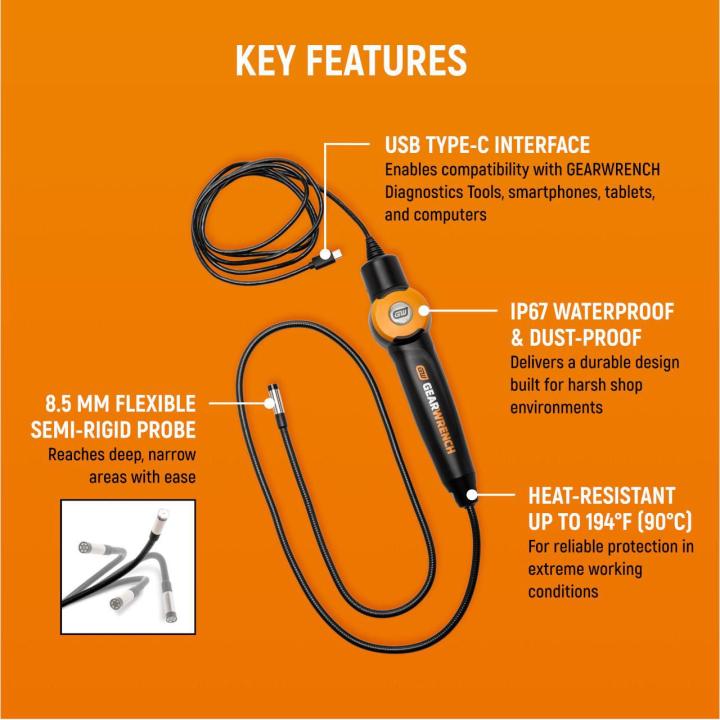
Flexible Borescopes: Structure And Features
Flexible borescopes are a newer development. Their main advantage is right in the name—they can bend and move around obstacles.
Core Design
A flexible borescope uses a bundle of optical fibers (for image and light transmission) or a tiny camera (in video borescopes) inside a flexible sheath. The user can guide the tip through curved spaces.
- Length: From 30 cm up to several meters.
- Diameter: As small as 0.5 mm for some models.
- Material: Flexible plastic or coated metal.
Image Quality
Image quality depends on the model. Fiber optic scopes may show a “honeycomb” pattern due to the fibers, while video borescopes can offer high-resolution color video. However, there is usually more light loss or blur compared to rigid types.
Typical Applications
Flexible borescopes shine in jobs where a straight path is not possible:
- Aircraft maintenance: Inspecting behind curved panels or deep inside engines.
- Plumbing: Checking inside winding pipes, drains, or sewer lines.
- Building inspection: Looking behind walls, inside ceilings, or through HVAC ducts.
- Security and law enforcement: Searching in hidden compartments.
Key Advantages
- Can navigate curves and bends
- Greater reach
- Versatile for many shapes and sizes
- Can access more locations
Main Limitations
- Lower image quality (in some models)
- More fragile (fibers can break)
- Higher cost for advanced features
Rigid Vs Flexible Borescopes: Direct Comparison
To make the differences clear, here’s a head-to-head comparison.
| Feature | Rigid Borescope | Flexible Borescope |
|---|---|---|
| Body Structure | Solid, straight tube | Bendable, flexible shaft |
| Image Quality | Very high (optical lenses) | Varies (fiber or camera) |
| Best Use | Straight, open areas | Curved, complex paths |
| Typical Length | 10–50 cm | 30 cm–5+ meters |
| Durability | Very durable | Less durable |
| Cost | Lower | Higher |
| Common Users | Engineers, mechanics | Plumbers, inspectors |

How To Choose: Which Borescope Suits Your Needs?
Choosing between rigid and flexible borescopes depends on several factors. Here are some points to consider before making your decision.
1. Shape Of The Inspection Area
If the space you need to inspect is straight and accessible, a rigid borescope is usually the best choice. But if you must go around corners, through twists, or into hidden areas, a flexible borescope is essential.
Example: Inspecting a car’s cylinder head is best with a rigid borescope. But tracing a leak inside a winding pipe will require a flexible model.
2. Image Quality Needed
For applications where you must see tiny details—like micro-cracks, corrosion, or wear—a rigid borescope gives the clearest, sharpest image. Flexible borescopes, especially cheaper ones, may not show fine details as well.
3. Working Environment
- Tough, industrial settings: Rigid borescopes are more robust and last longer.
- Confined, variable spaces: Flexible borescopes adapt to the environment.
4. Budget
Rigid borescopes are generally less expensive, especially for basic models. Flexible borescopes with high-end cameras or long lengths can be costly. For some jobs, the extra price is worth it.
5. Cleaning And Maintenance
Rigid borescopes are easier to clean and maintain due to their simple design. Flexible borescopes require more careful handling and may need special cleaning tools.
Data And Performance: What The Numbers Say
Recent studies and industry surveys show clear patterns in borescope use:
- Around 65% of aviation engine inspections are done with rigid borescopes because of the need for high image quality.
- In plumbing and building inspection, over 80% of professionals use flexible borescopes, as pipes and ducts rarely run straight.
- The average lifespan of a rigid borescope is 2–5 years with regular use. Flexible borescopes often need repair or replacement after 1–3 years, mainly due to fiber breakage or camera issues.
Here’s a summary of durability and cost from real-world usage:
| Borescope Type | Average Lifespan | Typical Price Range | Maintenance Level |
|---|---|---|---|
| Rigid | 2–5 years | $300–$2,000 | Low |
| Flexible | 1–3 years | $500–$10,000 | Medium to High |

Advanced Features: What To Look For
Both rigid and flexible borescopes now come with advanced features. These can affect price, performance, and suitability.
Useful Features In Rigid Borescopes
- Interchangeable lenses for different viewing angles (0°, 30°, 70°)
- LED illumination for better lighting inside dark spaces
- Digital camera adapters to capture still images or video
- Waterproof designs for industrial or medical use
Useful Features In Flexible Borescopes
- Articulating tips that you can steer remotely
- High-resolution video for clear inspection and recording
- Wireless connectivity to smartphones or tablets
- Long cable lengths for deep or distant inspections
Not all features are necessary for every user. For example, a plumber may need a very long, waterproof flexible borescope, while an engine technician values sharp optics and a sturdy body.
Common Mistakes When Choosing A Borescope
Even experienced professionals can make mistakes when selecting a borescope. Here are a few to avoid:
- Focusing only on price: Cheaper models often have poor image quality or break easily.
- Ignoring diameter: If your borescope is too thick, it won’t fit inside small openings. Always check the entry size first.
- Overlooking lighting: A great camera is useless without enough light. Check the LED strength and placement.
- Choosing flexible when rigid is enough: Flexible models are more complex and costly. If you only need straight-line inspection, save money with a rigid scope.
- Not considering cleaning: Some borescopes are hard to clean, especially after use in dirty or oily environments.
Non-obvious Insights You Should Know
Many beginners miss these important points:
- The angle of view matters as much as image quality. For example, a 90° side-view lens lets you inspect the walls of a cylinder, not just the bottom.
- Articulating tips on flexible borescopes can fail over time, especially if used forcefully. Consider models with easily replaceable tips.
- Rigid borescopes can be adapted with mirrors to see around corners, but these add-ons lower image clarity and are not as smooth as true flexible models.
Real-world Scenarios: When Each Type Excels
Let’s look at a few practical situations.
Aircraft Engine Inspection
Rigid borescope is chosen for its image clarity. Inspections look for small cracks or wear in turbine blades. A straight path is usually available through access ports.
Home Plumbing
A flexible borescope is essential. Pipes curve and may have multiple bends. The camera must follow the path and transmit video to a handheld screen for quick diagnosis.
Manufacturing Quality Control
If inspecting holes drilled in metal parts, a rigid borescope is used for fast, repeatable checks. The inspector quickly inserts and removes the scope, checking for defects.
Building Inspection
Flexible borescopes help examine behind walls, inside ceilings, or through complex HVAC systems. The ability to snake through obstacles is critical.
Future Trends
Technology is changing the borescope market:
- Video borescopes are replacing fiber optic versions, especially in flexible models. They offer better image quality and easier recording.
- Wireless connectivity means inspectors can share images in real time with remote teams.
- Miniaturization will allow even smaller diameters for inspecting tiny spaces, important in electronics or medical fields.
For more on the latest borescope technology and industry standards, you can check resources like Wikipedia.
Frequently Asked Questions
What Is The Main Difference Between Rigid And Flexible Borescopes?
The main difference is in the shaft. Rigid borescopes have a solid, straight tube and offer clearer images, but can’t bend. Flexible borescopes have a bendable shaft, letting you inspect around corners or inside curved spaces, but sometimes with lower image quality.
Which Type Of Borescope Is Better For Pipes?
A flexible borescope is better for pipes, drains, or any area with curves or bends. It can move through the twists, while a rigid scope can only inspect straight sections.
Are Rigid Borescopes Cheaper Than Flexible Ones?
In general, rigid borescopes are less expensive. Flexible borescopes, especially with high-resolution cameras or long cables, can cost much more.
Can Flexible Borescopes Be Used For All Inspections?
Not always. If you need the sharpest images or must inspect a straight, easy-to-access area, a rigid borescope may work better and last longer.
How Do I Maintain My Borescope To Make It Last Longer?
Always clean the scope after each use, avoid forcing it around tight corners (especially flexible models), store it in a protective case, and follow the manufacturer’s instructions for care.
Choosing between rigid and flexible borescopes comes down to your specific needs. Both types have their strengths and weaknesses. By understanding their differences, you can select the right tool for the job—and make your inspections faster, safer, and more effective.

